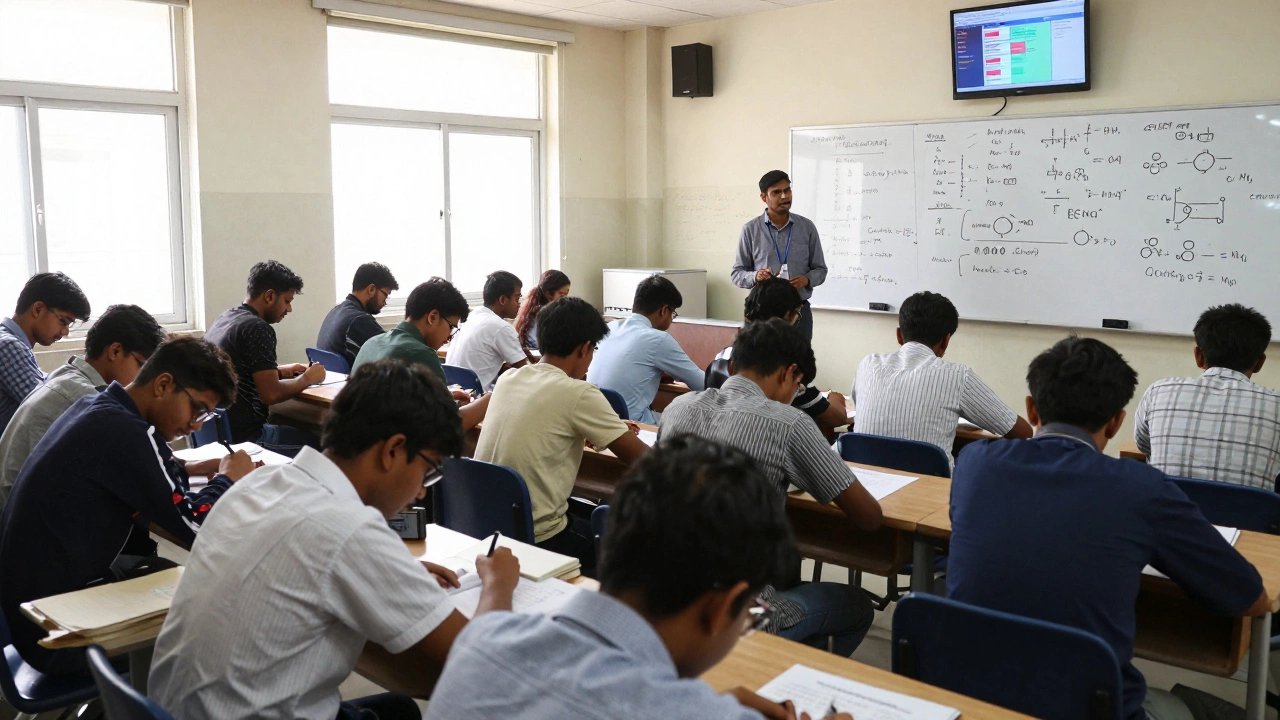
NEET Faculty Fitment Evaluator
Don't gamble with your year. Use this tool to audit a potential teacher's style against the ideal requirements for Biology, Physics, and Chemistry.
Analyze Teaching Style
Doubt & Support System
Success Evidence
Key Takeaways for Your Search
- Priority should be on conceptual clarity over shortcut tricks.
- The best faculty members emphasize NCERT line-by-line decoding.
- Check for a track record of improving 'average' students, not just toppers.
- Ensure the teacher provides a structured doubt-solving mechanism.
The Biology Specialists: Decoding the NCERT
Biology is the backbone of your score. Since it accounts for 50% of the marks, you can't afford a teacher who just reads the textbook to you. The best Biology faculty doesn't just tell you that the mitochondria is the powerhouse of the cell; they explain the evolutionary reason why it has its own DNA. Look for teachers who use visual mnemonics and flowcharts to simplify the Plant Kingdom or Human Physiology sections.
A red flag in biology faculty is someone who encourages you to study from heavy, external reference books before you've mastered the NCERT. In the current exam pattern, the NTA (National Testing Agency) often picks questions directly from the textbook lines. A great teacher will show you how to read between the lines of the textbook to find the hidden questions. For example, if a teacher can explain the specific conditions of the Calvin Cycle using a simple diagram rather than a five-page lecture, they are likely the right fit.
The Physics Experts: From Fear to Formula
Physics is where most NEET aspirants lose their confidence. You don't need a physicist; you need a coach. The best Physics faculty specializes in 'application.' They don't spend three hours deriving a formula that you'll never be asked to derive in the exam. Instead, they teach you how to identify which formula to apply the moment you read the problem.
Ask yourself: does the teacher solve a problem by jumping straight to the answer, or do they teach you how to visualize the scenario? A top-tier faculty member will break down Mechanics or Electromagnetism into digestible patterns. If they can take a complex projectile motion problem and turn it into two simple linear motions, they have the ability to simplify the subject for you. Avoid those who rely solely on 'magic tricks' or shortcuts; these fail the moment the NTA tweaks the question slightly.
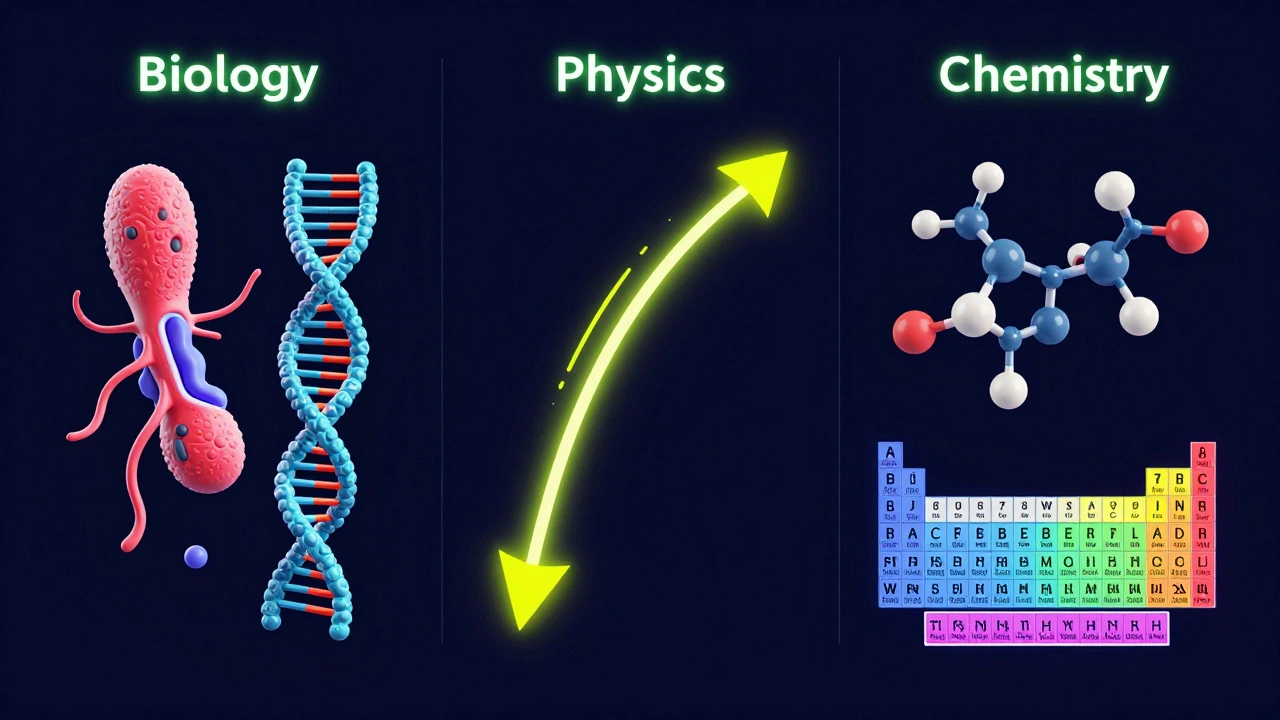
The Chemistry Balance: Physical, Organic, and Inorganic
Chemistry is a triple-threat, and rarely does one teacher excel in all three areas. The best chemistry faculty usually has a strategy for each sub-section. For Physical Chemistry, you need someone who treats it like physics-focusing on calculation speed and accuracy. For Organic Chemistry, you need a teacher who explains the 'why' behind the mechanism (like inductive effects or resonance) rather than making you memorize a thousand named reactions.
Then there is Inorganic Chemistry, which is essentially the biology of chemistry. The best faculty here will provide you with 'memory maps' and periodic table hacks that make the properties of p-block or d-block elements feel logical rather than random. If a teacher tells you to just 'memorize' the entire inorganic section without providing a framework for understanding, keep looking.
| Feature | The 'Star' Faculty | The 'Mentor' Faculty |
|---|---|---|
| Teaching Style | High energy, focuses on toppers | Patient, focuses on conceptual gaps |
| Doubt Resolution | Limited to specific hours/batch | Open, personalized feedback |
| Material | Standardized modules | Customized shortcuts and maps |
| Success Metric | Number of AIR 1-100 | Percentage of students improving scores |
How to Audit a Teacher Before Joining
Don't trust the brochure. The best way to find the right faculty is to conduct a 'trial audit.' Most coaching centers offer a few demo classes, but don't just sit there and listen. Try this: take a topic you find incredibly difficult-say, Rotational Dynamics or Ionic Equilibrium-and see if you can actually solve a medium-difficulty problem after their lecture. If you're still confused but the teacher is 'impressive,' that's a sign they are good at performing, not teaching.
Check their interaction with students during the Q&A session. Do they dismiss 'silly' questions, or do they use them as a stepping stone to explain a deeper concept? A teacher who can handle a basic question with patience is usually the one who can help you climb from a 400 score to a 600 score. Also, look for faculty who emphasize Mock Tests and analysis. A teacher who only lectures but doesn't analyze your mistakes is just a lecturer, not a coach.

The Role of Hybrid Learning
In 2026, the 'best' faculty is often a combination. You might have a local mentor for physical doubt clearing and a top-tier online expert for high-level conceptual lectures. Many students now use Learning Management Systems (LMS) to access recorded sessions from renowned teachers while attending offline classes for discipline. This hybrid approach allows you to pause and rewind a complex explanation of the Krebs Cycle, which you can't do in a live classroom.
When choosing, consider if the faculty uses technology to enhance learning. Do they use 3D animations for anatomy? Do they provide digital quizzes that give instant feedback? A faculty member who is stagnant in their methods often produces stagnant results. The evolution of the NEET exam requires a teacher who evolves their strategy every year based on the latest NTA trends.
Is a teacher with 20 years of experience always better?
Not necessarily. While experience is great, NEET patterns shift. A teacher who taught the 'old' style of NEET might not be as effective as someone who understands the current shift toward more assertion-reasoning and statement-based questions. Look for experience combined with a willingness to update their pedagogy.
Should I prefer a single teacher for all of Chemistry?
Ideally, no. Physical, Organic, and Inorganic Chemistry are very different animals. Many top institutes assign different specialists for each. If you're in a small center, ensure the teacher has a clear, distinct strategy for each of the three branches.
How do I know if a faculty is just 'selling' a dream?
If the teacher spends more time talking about their previous students' ranks than explaining a concept during a demo class, be wary. A real educator focuses on the process-how to solve, how to analyze, and how to revise-rather than just the result.
What is more important: the teacher's reputation or the batch size?
Batch size often outweighs reputation. The most famous teacher in the country is useless to you if you are one of 500 students in a room and can't get your doubts answered. A moderately famous teacher in a batch of 30 is often a better choice for actual growth.
Can I rely entirely on YouTube faculty for NEET?
YouTube is excellent for conceptual clarity, but it lacks accountability and a structured feedback loop. You can use it as a supplement, but for a competitive exam like NEET, you need a faculty member who tracks your progress and pushes you through a rigorous schedule of tests.
Next Steps for Your Selection
If you are still undecided, start by listing your weakest subject. If Physics is your nightmare, prioritize the Physics faculty over everything else; you can always find a great Biology teacher online. Once you've shortlisted three options, attend a full chapter's worth of classes, not just a 30-minute intro. This will reveal if the teacher can maintain the flow and keep you engaged for the long haul.
Finally, talk to students who are currently in the 'intermediate' range-those scoring 400-500. Their perspective on the faculty's ability to explain things simply is far more valuable than the perspective of a topper who might have been naturally gifted regardless of the teacher.