
Google Certificate Hiring Potential Calculator
Not sure if you're ready to apply? Use this tool to assess how well you've prepared beyond the certificate itself. Remember: The certificate opens the door, but your preparation walks through it.
Waiting for Input...
You’ve spent months grinding through modules. You’ve passed the assessments. You’re holding a digital badge that says Google Career Certificate is yours. Now comes the terrifying part: hitting "apply" and wondering if anyone actually cares.
The short answer? Yes, people get hired. But it’s not because the certificate itself is magic dust. It’s because the certificate signals something specific to employers: you have practical, tested skills in a high-demand field, and you learned them in a way that mimics real work. If you think this piece of paper replaces a degree or guarantees a job on its own, you’re setting yourself up for disappointment. But if you treat it as the foundation of a portfolio, it becomes a powerful launchpad.
The Shift from Degrees to Skills
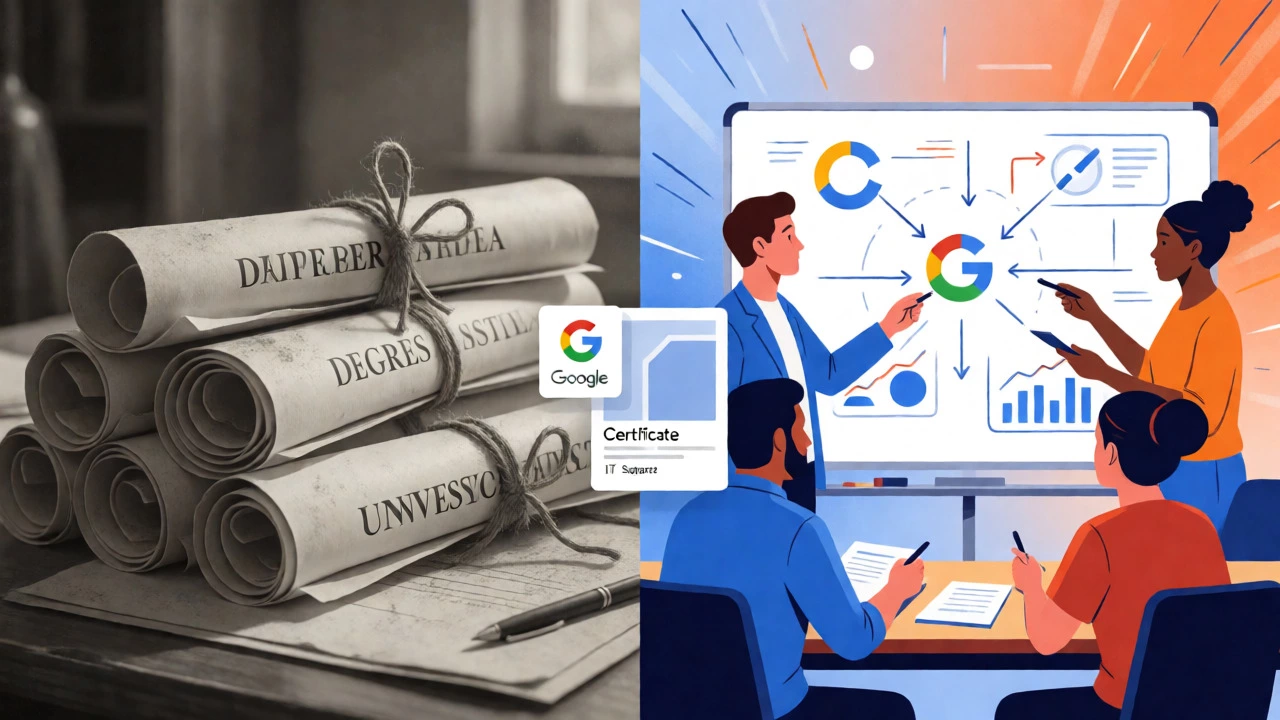
For decades, the bachelor’s degree was the golden ticket. If you didn’t have one, your resume often got filtered out by an algorithm before a human ever saw it. That landscape has shifted dramatically. Companies like Google, IBM, and Apple have publicly moved away from strict degree requirements for many entry-level roles. They are adopting "skills-first" hiring practices.
This doesn’t mean degrees are dead. It means they aren’t the only key to the door anymore. The Google Career Certificate programs (like Data Analytics, IT Support, Project Management, and UX Design) were built specifically to fill this gap. They partner with companies that need these exact skills. When a recruiter looks at your profile, they aren’t just seeing a certificate; they’re seeing proof that you completed a curriculum designed *with* industry input.
What Employers Actually Look For
Let’s be real: no hiring manager wakes up hoping to hire someone solely because they finished a Coursera course. They wake up hoping to solve a business problem. Can this person fix my server issues? Can this person organize my chaotic project timeline? Can this person make sense of my sales data?
The certificate gets your foot in the door during the initial screening. It passes the keyword filters in Applicant Tracking Systems (ATS). But the interview is where you win or lose. Here is what recruiters are actually hunting for when they see a Google Certificate on a resume:
- Practical Application: Did you just watch videos, or did you build things? The capstone projects in these certificates are crucial. You need to talk about them.
- Problem-Solving Logic: Can you explain why you chose a certain tool or method? The certificate proves you know the "what," but your interview answers prove you know the "how" and "why."
- Growth Mindset: Completing a rigorous program while working or studying shows discipline. Employers value grit.
| Credential Type | Perceived Value | Best Used For |
|---|---|---|
| Bachelor's Degree | High (General Foundation) | Long-term leadership tracks, traditional corporate roles |
| Google Certificate | Medium-High (Specific Skill Proof) | Entry-level tech, pivoting careers, proving recent knowledge |
| Self-Taught (No Cert) | Low-Medium (Hard to Verify) | Freelancing, startups with flexible cultures |
| Bootcamp | Medium (Intensive Training) | Fast-track coding or design roles |
The Portfolio Is Your Secret Weapon
Here is the mistake most people make: they put the certificate on LinkedIn and stop there. That’s like buying a guitar and never playing it. The certificate validates the learning, but the portfolio validates the ability.
If you did the Data Analytics certificate, don’t just say you know SQL and Tableau. Show me a dashboard you built analyzing real-world public data. Explain the insights you found. If you did the UX Design certificate, show me a case study where you redesigned an app interface and improved user flow.
Recruiters spend about six seconds scanning a resume. In those six seconds, a link to a live portfolio project stands out far more than a line item saying "Completed Google Course." Treat every module project as a potential portfolio piece. Polish them. Put them on GitHub or Behance. This turns an abstract credential into concrete evidence of competence.
Which Roles Are Most Open to This Path?
Not all industries move at the same speed. Tech, marketing, and operations are generally faster to accept alternative credentials than law, medicine, or academia. Within the tech sphere, some roles are much more open to certificate holders than others.
IT Support Specialist roles are highly receptive. Why? Because the day-to-day work is procedural and technical. If you can troubleshoot networks and manage systems-which the certificate teaches-you can do the job. A degree in Computer Science might teach you compiler theory, which is useless for resetting passwords or configuring routers.
Project Manager roles also welcome this path, especially in agile environments. The certificate covers Agile, Scrum, and risk management. These are hard skills that save companies money. If you can demonstrate you understand how to keep a project on track, your educational background matters less than your organizational capability.
However, be cautious with roles like Software Engineer. While the Google IT Automation with Python certificate is great, many engineering teams still prefer candidates who can pass complex whiteboard coding interviews, which often require deeper theoretical knowledge than a certificate provides alone. Pairing a certificate with a strong GitHub repository of original code helps bridge this gap.
Navigating the Interview Conversation
When you walk into an interview with a Google Certificate but no relevant work experience, you will get asked: "Tell me about a time you solved a difficult problem." Since you haven't worked in the field yet, you must use your coursework as your experience.
Don't say, "I learned about SQL." Say, "In my final project, I encountered a dataset with missing values that skewed our predictions. I used SQL to identify the gaps and implemented a median imputation strategy, which improved model accuracy by 15%." See the difference? One is passive learning; the other is active problem-solving.
Be ready to defend your choice of path. Some traditional managers might ask why you didn't get a degree. Have a confident answer ready. "I wanted to focus on practical, job-ready skills immediately rather than spending four years on general education. This program allowed me to master [specific skill] quickly, which I believe makes me productive from day one."

Salary Expectations and Reality Checks
Will you earn the same as a university graduate on day one? Probably not. Entry-level salaries for certificate holders often start slightly lower than those for degree holders in the same role, but the gap closes quickly. Once you have 1-2 years of experience, your performance matters infinitely more than your diploma.
In Australia, for example, an entry-level IT Support role might pay between AUD $50,000 and $60,000. A Data Analyst role might start around AUD $65,000 to $75,000. These figures vary by city-Melbourne and Sydney tend to offer higher starting wages due to cost of living and demand-but the trajectory is upward. The key is getting that first break. Once you are in, the certificate becomes irrelevant history; your output becomes your reputation.
The Verdict: Worth It?
Is it worth the time and money? If you are looking to pivot careers without taking on massive student debt, absolutely. The ROI on a Google Certificate is high because the barrier to entry is low compared to a degree, but the perceived credibility is surprisingly strong.
But remember: the certificate is a ticket, not the destination. It opens the door. You still have to walk through it, shake hands, and do the work. Use the network provided by the platform. Connect with instructors. Join local meetups. Attend virtual career fairs hosted by Google. Don't let the certificate sit idle on your LinkedIn profile. Build, create, and apply relentlessly.
Do all companies accept Google Certificates?
Not all, but many major tech companies and their partners do. Google explicitly states that these certificates are recognized by over 150 hiring partners, including firms like Deloitte, Verizon, and Walmart. However, smaller local businesses or very traditional corporations may still prioritize degrees. Always research the specific company's culture before applying.
Can I get a job with only a Google Certificate and no experience?
Yes, it is possible, but it requires effort. You must compensate for the lack of professional experience by building a strong portfolio of projects from your coursework. Highlighting transferable soft skills from previous unrelated jobs also helps significantly.
How long does it take to complete a Google Certificate?
Most programs take between 3 to 6 months if you dedicate about 10 hours per week. The pace is self-paced, so you can go faster if you have more time. Consistency is key-rushing through often leads to shallow understanding.
Is the Google Certificate better than a bootcamp?
It depends on your goals. Bootcamps are often more intensive, expensive, and focused on deep immersion, sometimes including job placement services. Google Certificates are cheaper, flexible, and great for self-starters who want to learn alongside other commitments. Neither is inherently "better"; they serve different learner types.
Does the certificate expire?
No, the certificate itself does not expire. However, technology changes rapidly. Skills in areas like cloud computing or AI evolve quickly. It is wise to update your knowledge regularly even if the certificate remains valid indefinitely.