
English Learning Routine Builder
Build your perfect daily English practice routine using proven methods from the guide. Select activities that fit your schedule for maximum consistency.
Choose Your Daily Activities
Your Personalized Routine
Select activities above to build your routine
You don’t need a fancy classroom or an expensive tutor to get better at English. In fact, some of the fastest progress happens when you stop treating it like a subject and start treating it like a lifestyle. If you are sitting in your living room in Melbourne, London, or Mumbai, the tools are already in your pocket. The problem isn’t access; it’s consistency. Most people fail because they wait for "free time" that never comes. They try to study for three hours on Sunday instead of thirty minutes every day. That approach burns you out. Here is how to flip the script and actually see results within weeks.
The Input Hypothesis: Why Listening Comes First
Before you can speak fluently, you need a library of sounds in your head. Linguists call this comprehensible input, which means consuming content that is slightly above your current level but still understandable. If you listen to advanced news reports when you are a beginner, your brain tunes out. It’s noise. You need to find the sweet spot where you understand 70-80% of what is being said.
In 2026, the best way to do this is through immersive media. Stop reading subtitles in your native language. Switch them to English. This forces your brain to connect the sound of the word with its meaning directly, rather than translating it first. Try watching sitcoms like Friends or The Office. Why these? Because they use everyday conversational English, not technical jargon. Pay attention to how characters interrupt each other, how they use slang, and how they form sentences under pressure. This is real-world data that textbooks often miss.
- Step 1: Watch a 20-minute episode with English subtitles.
- Step 2: Listen to the same scene without subtitles.
- Step 3: Shadow the dialogue-repeat exactly what the character says, mimicking their speed and emotion.
This technique, known as shadowing, builds muscle memory in your mouth. Your tongue needs to learn new shapes and positions. You cannot think your way into fluency; you have to train your physical ability to produce the sounds.
Speaking Alone: The Mirror Method
Many learners feel awkward talking to themselves. Good. Embrace it. Speaking alone removes the fear of judgment, which is the biggest blocker to fluency. When you worry about making mistakes, your brain freezes. When you talk to yourself, there is no audience. You can stumble, restart, and try again without shame.
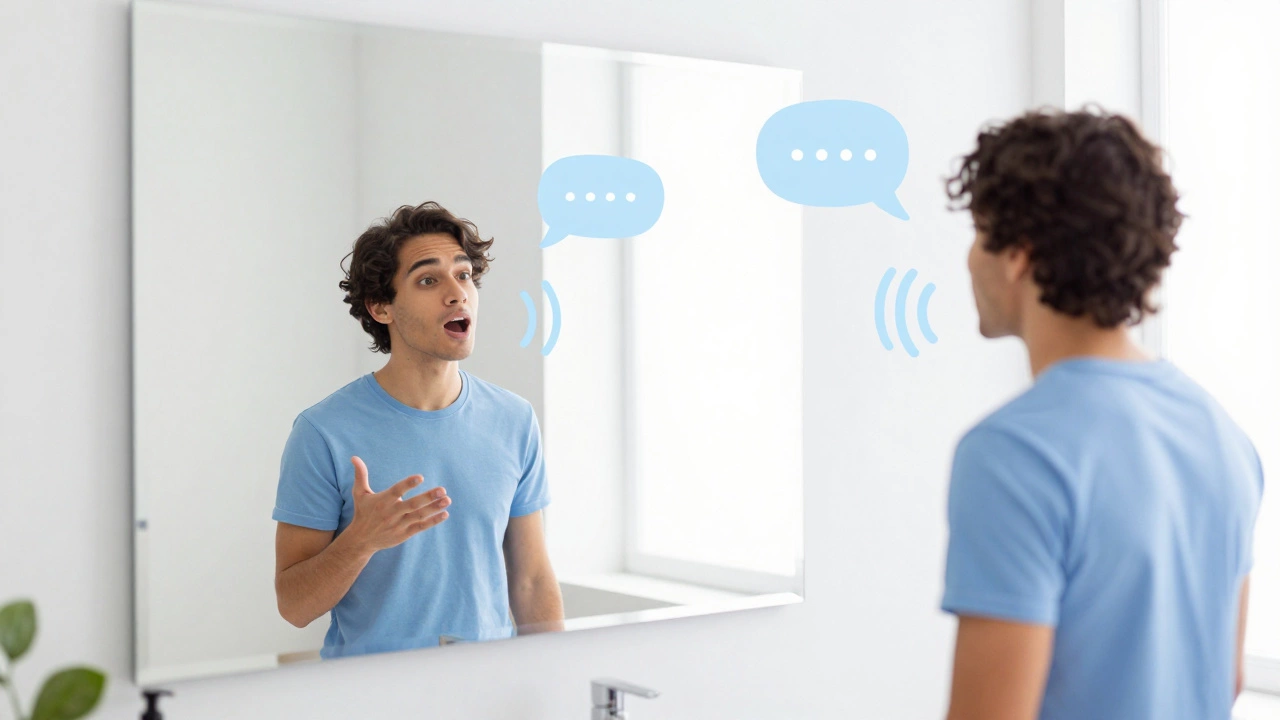
Try the Mirror Technique. Stand in front of a mirror for five minutes every morning. Describe what you are doing. "I am brushing my teeth. The water is cold. I need to buy more toothpaste." It sounds simple, but it forces you to retrieve vocabulary in real-time. If you get stuck on a word, write it down immediately after. Do not stop the flow to look it up. Keep moving. Later, review those missing words. This creates a personalized vocabulary list based on your actual needs, not a random textbook chapter.
You can also narrate your life while cooking or cleaning. "Now I am chopping the onions. They make me cry. I should open the window." This connects language to action. Memory sticks better when it is tied to sensory experience. You are not just learning the word "chop"; you are feeling the knife, seeing the onion, and smelling the air. That multi-sensory link makes the word permanent.
Changing Your Digital Environment
Your phone is probably the most powerful tool you own for learning English. Yet, most people keep it in their native language. Change that today. Switch your device’s operating system language to English. This forces you to interact with the interface in English every single day. You will learn words like "settings," "notifications," "storage," and "update" naturally because you need them to function.
Go further. Change the language of your social media feeds. Follow accounts that post in English. If you love cooking, follow English-speaking chefs. If you love tech, read reviews from English sources. The algorithm will soon feed you only English content. This is called digital immersion. You are creating a bubble where English is the default. Over time, your brain stops switching modes. It just accepts English as the normal state of communication.
Also, turn off auto-translate features. If you see a word you don’t know, guess the meaning from context before looking it up. This builds critical thinking skills. Context clues are essential for real conversations because you cannot pause someone to ask, "What does that mean?" You have to infer. Training your brain to infer now saves you embarrassment later.
The Power of Micro-Habits
Consistency beats intensity. Studying for one hour once a week is less effective than studying for ten minutes every day. This is due to spaced repetition, a psychological principle where information is reviewed at increasing intervals to move it from short-term to long-term memory. If you cram, you forget. If you space it out, you retain.
Create micro-habits that take less than five minutes. For example, learn one new idiom per day. Not ten. Just one. Use it in a sentence by the end of the day. Write it on a sticky note and put it on your fridge. See it multiple times. By the end of the month, you will know thirty idioms and how to use them. Idioms are crucial because they show cultural nuance. Saying "it’s raining cats and dogs" tells the listener you understand the culture, not just the grammar.
Another micro-habit is the "one-word-a-day" rule. Pick a complex word like "ubiquitous" or "ephemeral." Write its definition, a synonym, and an antonym. Then, force yourself to use it in a text message or email. Active usage cements the word. Passive recognition is weak; active production is strong. You want to be able to pull the word out when you need it, not just recognize it when you see it.
Using AI as a Conversation Partner
In 2026, artificial intelligence has become a legitimate tool for language learning. Apps like Duolingo Max or generic large language models can act as infinite conversation partners. Unlike human tutors, AI does not judge your accent. It does not get tired. It is available at 3 AM if you are awake and anxious to practice.
Use AI to simulate specific scenarios. Tell the bot, "Pretend you are a barista in New York. I want to order a coffee." Then, have a conversation. Ask it to correct your grammar after the chat. Most AI tools offer a "correction mode" where they highlight errors and explain why they are wrong. This immediate feedback loop is faster than waiting for a teacher to grade your homework. It turns mistakes into instant lessons.
However, do not rely solely on AI. It lacks emotional depth and cultural subtlety. Use it for drills and vocabulary building, but seek human interaction for nuance. Join online communities like Reddit’s r/EnglishLearning or Discord servers dedicated to language exchange. These platforms connect you with native speakers who are willing to help. The key is reciprocity. Offer to help them with your native language in exchange for English practice. This builds relationships, not just skills.
| Method | Cost | Time Commitment | Best For |
|---|---|---|---|
| Private Tutor | High ($20-$50/hr) | Structured (1-2 hrs/week) | Grammar correction, exam prep |
| AI Chatbots | Low (Free-$10/mo) | Flexible (Anytime) | Vocabulary, casual conversation |
| Immersion Media | Low (Subscription fees) | Passive (Daily) | Listening skills, pronunciation |
| Self-Study Habits | Zero | Micro (5-10 mins/day) | Long-term retention, consistency |

Avoiding Common Pitfalls
One major mistake is focusing too much on grammar rules. Grammar is important, but it is not the priority for quick improvement. Communication is. If you say "I go store yesterday," people understand you. If you say "I went to the store yesterday," you sound better. But if you hesitate for five minutes to conjugate the verb correctly, you lose the flow. Fluency comes from flowing, not from perfecting. Fix grammar later, once you can speak freely.
Another pitfall is perfectionism. You will make mistakes. You will sound silly. Accept it. Every native speaker made mistakes when they were learning. Even adults who learn a second language struggle with accents. Your goal is not to sound like a BBC news anchor. Your goal is to be understood. Confidence grows when you accept imperfection. The more you speak, the less you care about small errors.
Finally, avoid comparing yourself to others. Social media shows highlights, not struggles. Someone might claim they learned English in three months. Maybe they did. Maybe they didn’t. Your journey is unique. Focus on your own progress. Track your wins. Did you understand a joke last week that confused you today? That is progress. Did you dream in English? That is huge progress. Celebrate these small victories.
Building a Sustainable Routine
To make this stick, integrate English into your existing habits. Do not create a new habit from scratch. Attach it to something you already do. For example, listen to an English podcast while commuting. Read English news while drinking coffee. Practice speaking while showering. This is called habit stacking. It reduces the mental effort required to start. You are not deciding to study; you are just continuing your morning routine.
Set realistic goals. Instead of "I will be fluent in six months," try "I will speak for five minutes every day." Small, achievable goals build momentum. Momentum builds confidence. Confidence leads to more practice. It is a positive feedback loop. Break big goals into tiny steps. Want to watch a movie without subtitles? Start by watching cartoons. Then animated movies. Then sitcoms. Then dramas. Each step prepares you for the next.
Remember, language is a skill, not knowledge. You cannot learn to ride a bike by reading a book about physics. You must get on the bike and fall. Similarly, you cannot learn English by only reading grammar books. You must speak, listen, and engage. The more you expose yourself to the language, the faster you will improve. Start today. Not tomorrow. Today.
How long does it take to improve English significantly?
With consistent daily practice of 30-60 minutes, most learners notice significant improvement in 3-6 months. Key factors include immersion, active speaking, and spaced repetition. Quick gains come from focusing on high-frequency vocabulary and common phrases rather than complex grammar rules.
Can I really learn English without a tutor?
Yes. Many successful learners use self-study methods like shadowing, digital immersion, and AI conversation partners. Tutors provide structure and correction, but they are not essential if you discipline yourself to consume English content daily and practice speaking aloud regularly.
What is the best app for practicing English speaking?
Apps like Duolingo Max, ELSA Speak, and HelloTalk are excellent. ELSA focuses on pronunciation using AI voice analysis. HelloTalk connects you with native speakers for text and voice exchanges. Choose based on whether you prefer structured drills or human interaction.
Should I watch movies with subtitles?
Yes, but switch to English subtitles, not your native language. This helps your brain associate sounds with meanings directly. As you improve, gradually remove subtitles entirely to challenge your listening comprehension and reduce reliance on visual cues.
How do I overcome fear of speaking?
Start by speaking alone. Use the mirror technique or narrate your daily actions. This builds confidence without the pressure of judgment. Gradually move to low-stakes interactions with AI bots or friendly language exchange partners before attempting professional conversations.