CBSE vs. US Syllabus Compatibility Checker
Answer the questions below to see which system aligns best with your strengths and future plans.
Your Recommended System
*This tool provides a general indication based on common student experiences described in the article.
Ask any student who has moved between India and the United States, or even just compared notes with peers online, and you will hear a heated debate. One side claims American syllabus is a breeze because there is no rote memorization. The other side argues that CBSE (Central Board of Secondary Education) is actually more logical once you get past the volume. So, which one is truly "easier"?
The truth is, neither is universally easier. They are difficult in completely different ways. If you define "easy" as having less to memorize for an exam, the American system wins. If you define "easy" as having clear, predictable answers and a structured path, many students find CBSE more manageable. Let’s break down why these two systems feel so different, where the real pressure points are, and what this means if you are planning your education.
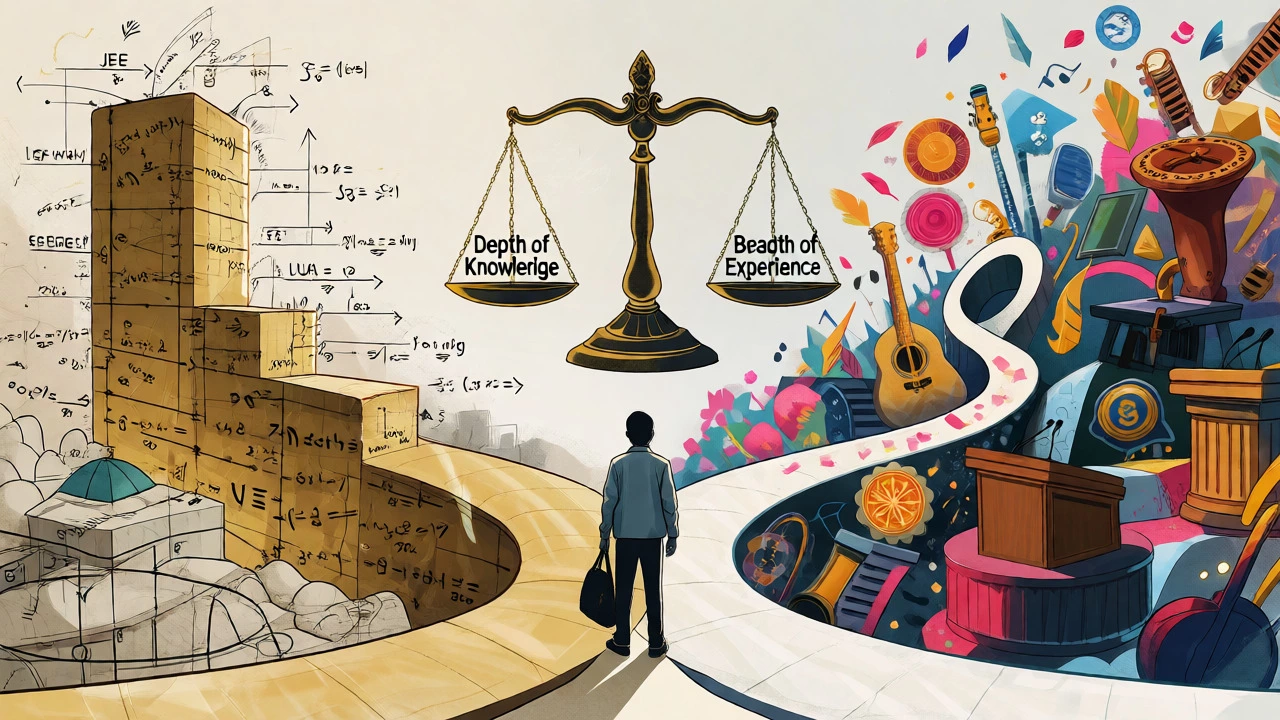
The Core Philosophy: Depth vs. Breadth
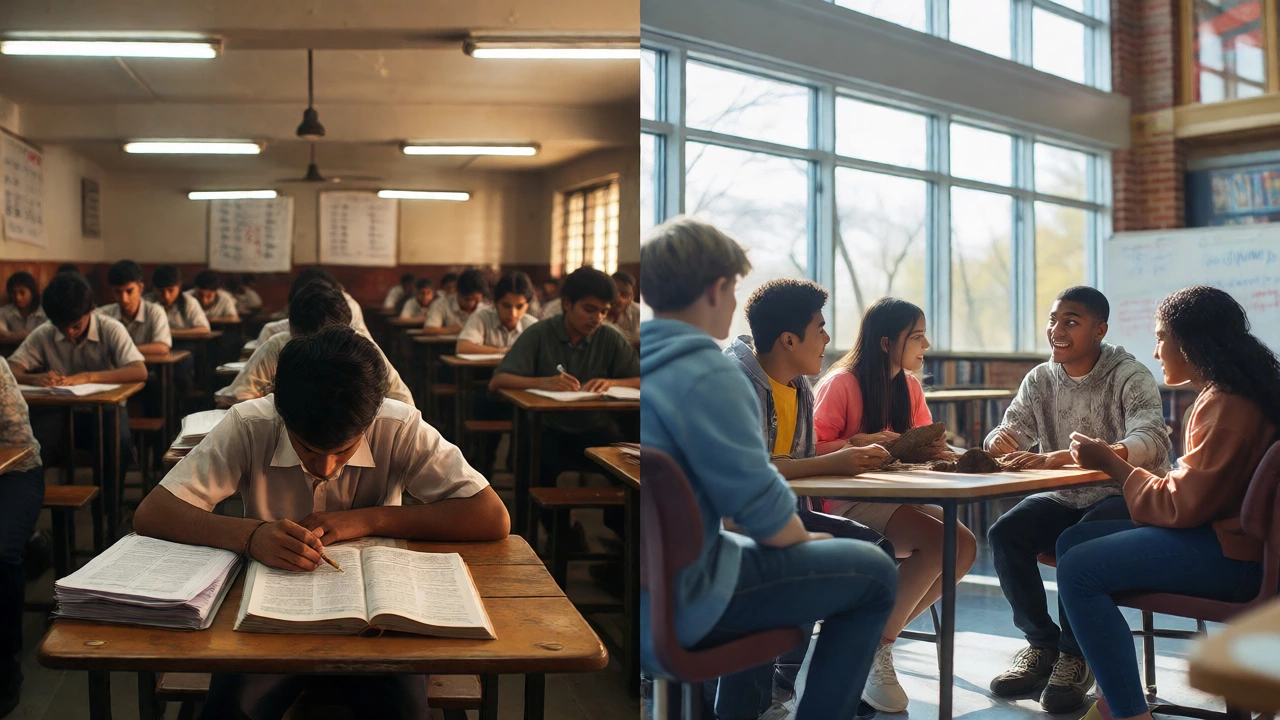
To understand the difficulty, you have to look at what each system values. CBSE, governed by the National Council of Educational Research and Training (NCERT) in India, focuses heavily on conceptual clarity within a rigid framework. The curriculum is designed to ensure every student in the country reaches a certain baseline of knowledge in Science and Mathematics. This results in a syllabus that is dense and fast-paced. You don’t just learn Newton’s laws; you solve complex numerical problems based on them under time pressure.
In contrast, the American syllabus varies by state and district but generally prioritizes critical thinking, application, and breadth over depth. In a typical US high school, you might take a class called "Earth Science." Instead of memorizing specific rock formations for a final exam, you might spend weeks analyzing local soil samples and writing reports. The content feels lighter, but the expectations for independent thought are higher. You aren’t asked "What is the capital of France?" You are asked "Why did the French Revolution happen, and how does it compare to modern political movements?"
This difference creates a psychological shift. For a student used to CBSE, the American style can feel unstructured and vague. Where is the textbook answer? How do I know if my essay is correct? Conversely, for an American student, the CBSE approach can feel overwhelming because of the sheer volume of facts and formulas they need to retain perfectly.
Assessment Styles: The Source of Stress
The biggest factor determining perceived difficulty is how you are graded. This is where the gap widens significantly.
| Feature | CBSE System | American High School System |
|---|---|---|
| Primary Grading | End-of-year board exams (Class 10 & 12) | Continuous assessment (Quizzes, Projects, Participation) |
| Exam Format | Written theory papers, strict word limits | Mix of multiple-choice, essays, labs, presentations |
| Pass/Fail Criteria | High stakes: One bad day can lower your entire grade | Low stakes per assignment: You can recover from failures |
| Subject Choice | Limited streams (Science, Commerce, Arts) | High flexibility: Mix AP classes with electives |
In the CBSE system, everything builds toward those two massive years: Class 10 and Class 12. These are "board exams." Your future college admissions often hinge entirely on these percentages. There is little room for error. If you have a bad stomach ache on exam day, your score drops. This creates immense anxiety. The questions are often direct, requiring precise recall of NCERT textbooks. Deviating from the textbook language can sometimes cost marks, even if your concept is right.
The American system spreads the risk. Your grade is usually an average of homework, quizzes, midterms, finals, and class participation. If you bomb a midterm, you can still get an A in the class by crushing the final project and doing well in daily work. This reduces the panic of a single high-stakes event. However, it requires consistent effort throughout the year. You cannot cram the night before. If you slack off for three weeks, your GPA takes a hit immediately.

Mathematics and Science: Who Has It Harder?
This is the most common point of contention. Parents often boast that their kids are doing calculus in 9th grade in India while American kids are still learning algebra. Is that true? Yes, and no.
CBSE Mathematics is rigorous and fast. By Class 10, students are expected to handle trigonometry and coordinate geometry with speed. In Class 12, Calculus is introduced deeply. The problems are often multi-step and require strong calculation skills. The focus is on solving standard types of problems quickly and accurately. It is excellent training for engineering entrance exams like JEE, but it can stifle creativity if you only care about getting the right number.
The American system offers tracks. A regular Algebra II class is much slower than CBSE Math. But if you take AP Calculus BC (Advanced Placement), the difficulty spikes. In fact, AP courses are often considered harder than CBSE equivalents because they require applying math to new, unseen scenarios rather than just repeating solved examples. So, comparing "average" CBSE to "average" US makes CBSE look harder. Comparing "top-tier" CBSE to "top-tier" US (AP/Honors) makes the American workload look heavier due to the emphasis on proof and logic.
Science follows a similar pattern. CBSE Physics and Chemistry are heavy on formulas and theoretical definitions. You memorize reactions and derivations. American science classes emphasize the scientific method. You spend hours in labs, writing lab reports, and discussing ethical implications of technology. You might know less about the periodic table by heart, but you might be better at designing an experiment to test a hypothesis.
The Hidden Curriculum: Soft Skills and Extracurriculars
If you think school ends when the bell rings, you are missing half the picture. The American syllabus includes a "hidden" requirement that CBSE largely ignores until college applications: extracurricular excellence.
In the US, being smart isn’t enough. You need to be interesting. Colleges want to see leadership, sports, community service, or artistic talent. This adds a layer of stress that doesn’t exist in the traditional CBSE environment. An Indian student might study 8 hours a day and be done. An American student aiming for top universities might study 4 hours, but then spend 3 hours practicing violin, 2 hours on debate club, and 1 hour volunteering. Balancing this social and creative load can be mentally exhausting in a way that pure bookwork isn’t.
Furthermore, communication skills are graded. In CBSE, you rarely present orally. In the US, oral presentations, group projects, and class discussions are part of your grade. If you are shy or struggle with English fluency (for non-native speakers), this becomes a significant hurdle. Many international students find that while they ace the written tests, they lose marks in participation because they are too quiet in class.
Which One Prepares You Better?
It depends on your goals. If you plan to stay in India and pursue engineering or medicine through competitive exams like JEE or NEET, the CBSE syllabus is directly aligned. It teaches you the discipline of studying hard facts and solving tricky numerical problems under pressure. The rigor is an asset here.
If you plan to move abroad for university, particularly to the US, UK, or Australia, the American-style education (or IB/Cambridge curricula) is often better preparation. Western universities value research skills, essay writing, and independent learning. Students coming from a strict CBSE background sometimes struggle in their first year of college abroad because they are used to waiting for instructions rather than asking questions. They have the knowledge, but not always the confidence to use it creatively.
However, don’t underestimate the adaptability of CBSE students. The mental toughness developed by handling the board exam pressure is invaluable. Once they adjust to the open-ended nature of Western assignments, they often excel because they have stronger foundational knowledge in STEM subjects.
Practical Tips for Navigating Both Systems
If you are switching between these systems or trying to decide which path to take, keep these strategies in mind:
- For CBSE Students Moving to the US: Focus on improving your English writing and speaking skills. Join clubs early. Don’t just rely on your grades; build a profile. Learn to ask questions in class-silence is interpreted as lack of interest.
- For US Students Switching to CBSE: Start memorizing formulas early. Practice past board papers relentlessly. Time yourself. Accuracy matters more than speed initially, but speed comes with practice. Accept that the teaching style will be more teacher-centric.
- For Everyone: Understand that "difficulty" is subjective. Find out what type of learner you are. Do you thrive on structure and clear answers (CBSE)? Or do you prefer freedom and self-directed projects (US)?
Ultimately, calling one syllabus "easier" is a trap. The American syllabus is easier on memory but harder on time management and soft skills. The CBSE syllabus is harder on volume and precision but provides a clearer roadmap. Neither is a walk in the park. Both require dedication, resilience, and a willingness to adapt.
Is the American syllabus really easier than CBSE?
Not necessarily. The American syllabus is often considered easier in terms of rote memorization and exam pressure, as grades are continuous. However, it demands more critical thinking, essay writing, and extracurricular involvement, which can be challenging for students accustomed to the structured, fact-heavy CBSE system.
Which syllabus is better for engineering aspirants?
If you plan to write Indian entrance exams like JEE Main or Advanced, the CBSE syllabus is more directly relevant because these exams are based on NCERT concepts. However, if you aim for US universities, the American AP curriculum or IB is preferred as it aligns with Western university expectations.
Do American students study less than CBSE students?
On paper, yes, the volume of content in CBSE textbooks is higher. However, American students often spend significant time on projects, reading assignments, and extracurricular activities. The total workload may be similar, but the nature of the work differs-CBSE is intensive study, while the US system is intensive engagement.
Is mathematics harder in CBSE or the US?
At the basic level, CBSE moves faster and covers more ground earlier. However, advanced American courses like AP Calculus or AB Statistics involve complex problem-solving and proofs that can be more intellectually demanding than standard CBSE exercises. The difficulty depends on whether you prioritize speed and formula application (CBSE) or logical derivation and application (US).
Can I switch from CBSE to an American syllabus easily?
Switching is possible but requires adjustment. The main challenges are adapting to continuous assessment instead of final exams, improving English proficiency for essays, and participating actively in class. Students often find the academic content manageable but struggle with the grading criteria and social aspects of the US system.