
High-Stakes Exam Comparison Tool
Select an exam below to see its specific challenges and requirements, or use the comparison table to analyze them side-by-side.
Gaokao
The National College Entrance Exam
UPSC
Civil Services Examination
IIT JEE
Joint Entrance Examination
Recommended Strategy:
-
Quick Comparison Matrix
| Exam | Focus | Main Hurdle | Difficulty Type |
|---|---|---|---|
| Gaokao | General Academic | Scale & Competition | Systemic Pressure |
| UPSC | Public Admin | Syllabus Breadth | Analytical Depth |
| IIT JEE | STEM/Engineering | Conceptual Rigor | Problem Solving |
Ever wondered why some people spend an entire year locked in a room, studying 16 hours a day, just for a single test? It sounds like a nightmare, but for millions of students across Asia and Europe, this is the reality of high-stakes testing. When we talk about the toughest exams in the world, we aren't just talking about a tricky math problem or a long essay. We are talking about tests where the failure rate is staggering, the competition is brutal, and the psychological pressure can be crushing.
Quick Summary: The Hardest Tests on Earth
- Gaokao (China): A brutal marathon of tests that determines a student's entire future in the Chinese education system.
- UPSC Civil Services (India): A multi-stage ordeal known for its massive syllabus and incredibly low success rate.
- IIT JEE (India): The gold standard for engineering entrance, where only the absolute top percentile make the cut.
The Gaokao: China's Educational Pressure Cooker
If you want to understand true academic stress, look at the Gaokao is the National College Entrance Examination in China, a standardized test administered annually for high school graduates. It is more than just a test; it's a societal rite of passage. For most students, this single event determines whether they get into a top-tier university or end up in a vocational school, which fundamentally alters their career trajectory and social standing.
The exam takes place over two days in June, focusing on core subjects like Chinese, Mathematics, and English. But the difficulty isn't just in the questions. It's the scale. Around 10 to 13 million students sit for this exam every year. Imagine being one of 12 million people fighting for a few thousand spots in the most prestigious universities like Peking University or Tsinghua University. The competition is so fierce that students often attend "cram schools" where they follow a rigid, military-like schedule for years before the actual test day.
One of the most striking things about the Gaokao is the level of national mobilization. Police escorts are used to transport test papers, and drones are deployed to catch cheaters. The pressure is so high that it's not uncommon to see parents waiting outside exam halls in total silence, praying for their children's success. It is an endurance test of memory, speed, and mental fortitude.
UPSC Civil Services: The Marathon of Intelligence
While the Gaokao is a sprint of high-pressure memory, the UPSC Civil Services Examination is a grueling marathon. Conducted by the Union Public Service Commission of India, this exam selects candidates for the Indian Administrative Service (IAS) and other top government roles. It is widely considered one of the most difficult competitive exams globally due to its sheer breadth of content.
The UPSC process is split into three distinct phases: the Prelims, the Mains, and the Personality Test (Interview). The Prelims act as a massive filter, where hundreds of thousands of candidates are whittled down to a few thousand. The Mains are where the real struggle begins. You have to write long-form essays and detailed answers on everything from ancient history and political science to ethics and international relations. It's not just about knowing the facts; it's about how you analyze a complex problem and present a solution under a tight time limit.
The numbers are terrifying. Every year, roughly 800,000 to 1 million people apply, but only about 0.1% to 0.5% actually make the final list. Many candidates spend 3 to 5 years of their lives studying full-time, often attempting the exam multiple times. The mental toll is significant, as a single bad day during the Mains can wipe out years of preparation. To succeed here, you don't just need a high IQ; you need an obsession with current affairs and an unmatched ability to synthesize information.
IIT JEE: The Peak of Mathematical Rigor
If the UPSC is about breadth, the IIT JEE is about depth and precision. The Joint Entrance Examination is the gateway to the Indian Institutes of Technology, the most prestigious engineering colleges in India. Unlike school exams where you can get partial marks for showing your work, the JEE is a ruthless objective test where a tiny calculation error can cost you a seat at a top college.
The exam is divided into JEE Main and JEE Advanced. JEE Main is the first hurdle, but JEE Advanced is the real monster. It tests Physics, Chemistry, and Mathematics at a level that often exceeds the standard high school curriculum. The questions are designed to be conceptually challenging, requiring students to apply multiple principles to solve a single problem. You aren't just reciting formulas; you're solving puzzles that have been engineered to trick you.
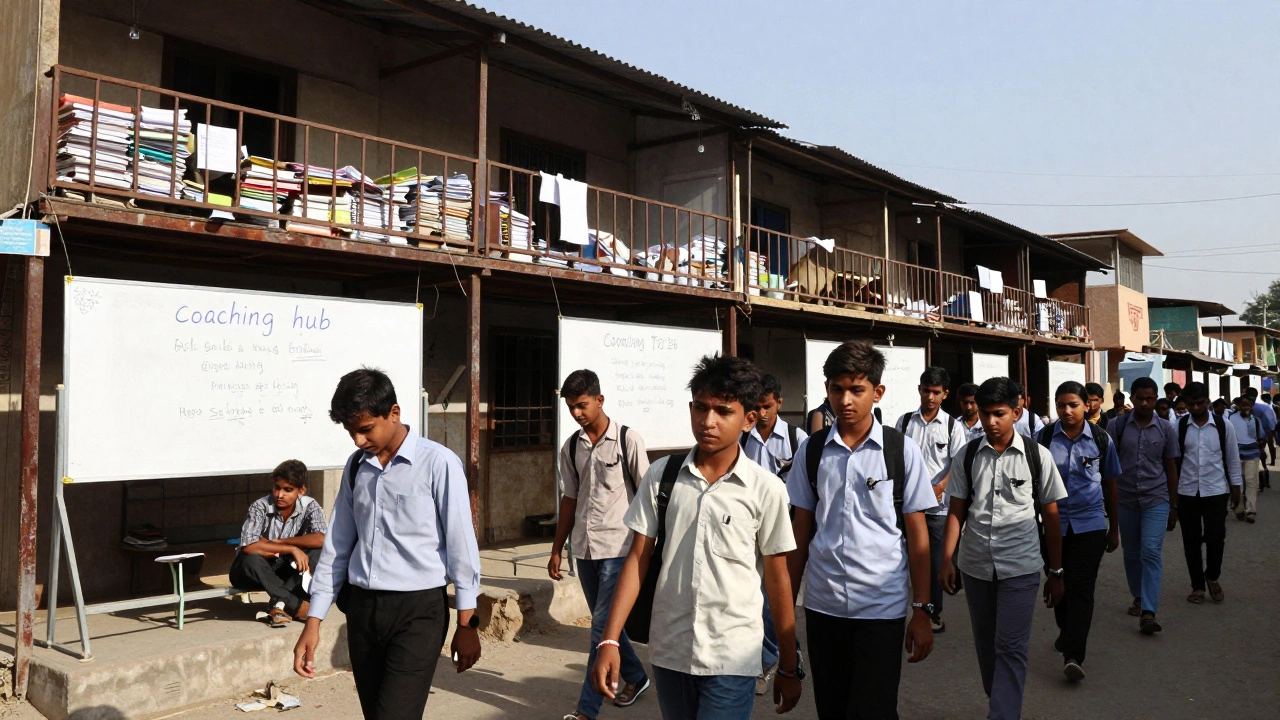
The environment surrounding the JEE is a subculture of its own. In cities like Kota, India, entire neighborhoods are dedicated to "coaching hubs." Students move there at 15 or 16 years old, living in hostels and studying for 12 to 14 hours a day. The goal is to enter the top 1% of the few hundred thousand candidates. For many, getting into an IIT is seen as a guaranteed ticket to a high-paying job in Silicon Valley or a top global firm, making the stakes incredibly high.

Comparing the Giants: Different Types of Hard
It's hard to say which one is truly the "toughest" because they test different things. The Gaokao is about systemic pressure and accuracy. The UPSC is about vast knowledge and analytical writing. The IIT JEE is about extreme problem-solving and mathematical mastery.
| Exam | Primary Focus | Key Challenge | Estimated Success Rate | Typical Prep Time |
|---|---|---|---|---|
| Gaokao | General Academic | Extreme competition / Scale | Very Low (for top tiers) | 3+ Years |
| UPSC | Public Administration | Syllabus breadth / Writing | ~0.1% - 0.5% | 2-5 Years |
| IIT JEE | STEM / Engineering | Conceptual complexity | ~1% - 2% (for top IITs) | 2-4 Years |
The Psychological Cost of High-Stakes Testing
Beyond the books and the formulas, there is a hidden cost to these exams. When a single test determines your social class, your income, and your parents' pride, the stress becomes systemic. In China, the term "involution" (neijuan) is often used to describe this race where everyone works harder and harder, but the rewards stay the same because everyone else is also working harder.
This pressure leads to burnout, anxiety, and in extreme cases, severe depression. Students often lose their teenage years to the grind. While the rigor produces world-class engineers and diplomats, it also creates a generation of students who are masters of test-taking but may struggle with creative thinking or emotional intelligence. The trade-off is a highly skilled workforce at the expense of personal well-being.
How to Survive a High-Pressure Exam
Whether you're tackling a professional certification or a national entrance exam, the approach to surviving these behemoths is similar. You can't just "study hard"; you have to study strategically. The most successful candidates usually follow a few specific patterns:
- Active Recall: Instead of reading a chapter five times, they test themselves. This forces the brain to retrieve information, which strengthens the memory.
- Spaced Repetition: They don't cram. They review a topic today, then in three days, then in a week. This moves information from short-term to long-term memory.
- Mock Testing: They simulate the exam environment exactly-same time of day, same desk, no phone-to build "exam stamina."
- Strategic Sacrifice: In exams like the UPSC, it's impossible to know everything. The pros learn which sections to prioritize and which to simply "pass" to maximize their total score.
Is the Gaokao harder than the IIT JEE?
It depends on the metric. In terms of total candidates and societal pressure, the Gaokao is likely harder because it is the only path to success for millions. However, in terms of the mathematical and scientific complexity of individual questions, the IIT JEE Advanced is generally more challenging.
What is the passing percentage of the UPSC exam?
The UPSC doesn't have a "pass rate" in the traditional sense because they only select a fixed number of candidates. Out of roughly 800,000 to 1 million applicants, only about 1,000 make the final list, meaning the success rate is often below 0.2%.
Can someone pass these exams without coaching?
Yes, but it is increasingly rare. With the rise of specialized coaching in places like Kota (for JEE) or Old Rajinder Nagar (for UPSC), the "bar" for passing has risen. Self-study is possible with high discipline and the right online resources, but coaching provides a structured roadmap and a benchmark for competition.
Are there other tough exams not mentioned here?
Absolutely. The Master Sommelier Diploma is legendary for its low pass rate, and the Mensa admission test is incredibly difficult. However, these are niche professional or IQ tests, whereas the Gaokao, UPSC, and JEE are "life-defining" for millions of young people.
How do these exams affect mental health?
The impact is significant. High rates of sleep deprivation, chronic stress, and "exam fever" are common. Many students experience a loss of identity, where their entire self-worth becomes tied to a rank or a score, leading to severe anxiety if they don't meet expectations.
Next Steps for Aspiring Candidates
If you are preparing for a high-stakes exam, the first thing to do is audit your resources. Don't just buy every book on the market; find a syllabus and map your progress against it. Focus on building a sustainable routine-burning out in the first six months is a common mistake. Ensure you have a support system of friends or mentors who understand the pressure you're under. Finally, remember that while these exams are incredibly tough, they are not the only way to find success in life. Many successful entrepreneurs and leaders failed these tests but found other paths to excellence.