
IIT JEE Admission Probability Calculator
Understand Your Real Odds
The article describes the IIT JEE as the world's most stressful exam with less than 0.8% selection rate. This calculator shows your actual admission probability based on your JEE Main performance.
Key Statistics
- 1.5M Students take JEE Main annually
- 250K Qualify for JEE Advanced
- 12K Admitted to IITs
Your estimated probability:
Based on current selection rates
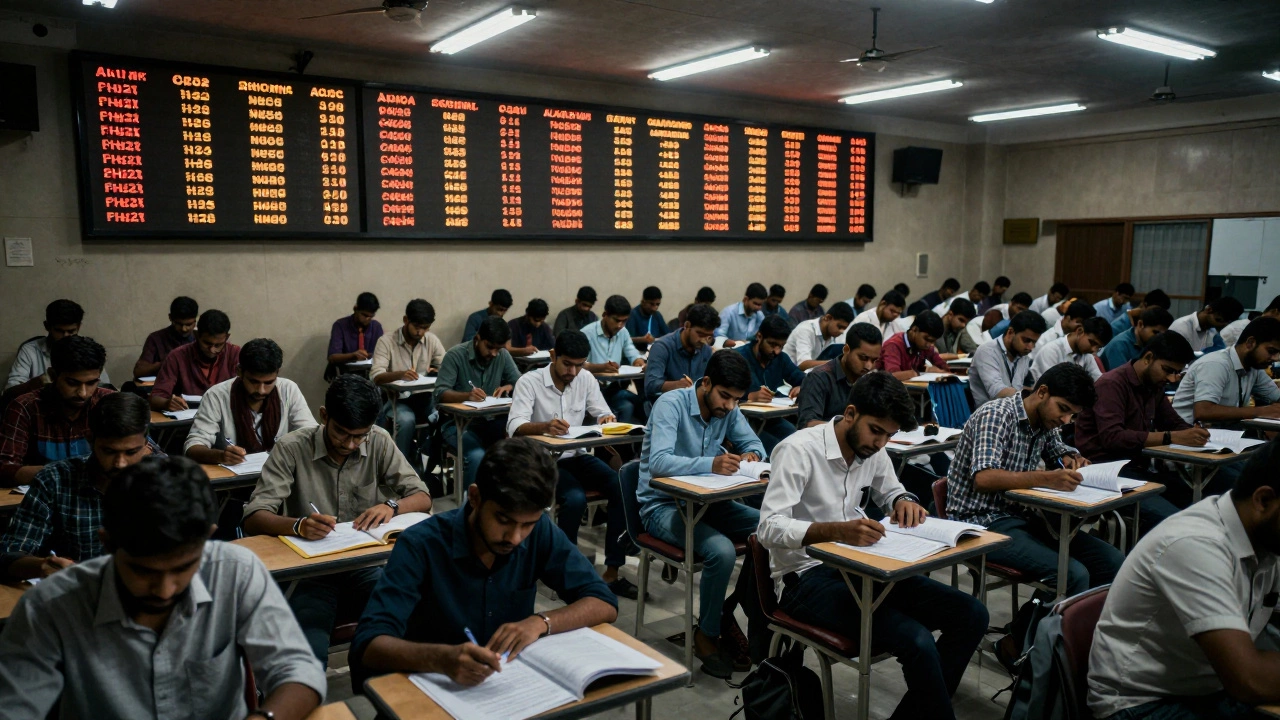
Imagine studying 14 hours a day for two years. Waking up at 4 a.m. to solve calculus problems before breakfast. Skipping birthdays, holidays, and even family dinners because one wrong answer could change your entire future. This isn’t a scene from a movie. This is the reality for hundreds of thousands of students taking the IIT JEE-widely considered the most stressful exam in the world.
The IIT JEE: More Than Just a Test
The Joint Entrance Examination (JEE) Advanced, which determines admission to India’s Indian Institutes of Technology, isn’t just hard-it’s a gauntlet. Over 1.5 million students take the JEE Main every year. Only about 250,000 qualify for JEE Advanced. Of those, fewer than 12,000 get into one of the 23 IITs. That’s a selection rate of less than 0.8%.What makes it so stressful isn’t just the difficulty. It’s the weight of expectation. Parents invest their life savings. Schools turn classrooms into pressure cookers. Students are ranked publicly on merit lists that determine their social status. A single mistake in a 3-hour paper can cost you a spot in the top 100. And the top 100? They get scholarships, job offers before graduation, and instant respect in a society where engineering degrees are seen as golden tickets.
Why It’s Worse Than Other High-Stakes Exams
People often compare IIT JEE to the Chinese Gaokao or the US SAT. But those exams don’t carry the same emotional and economic burden.The Gaokao is intense, yes. But it’s a single exam, taken once, with standardized content across the country. The SAT is just one part of a broader admissions process. IIT JEE, on the other hand, is a two-stage, three-paper, multi-subject marathon that starts in Class 11 and ends with a final, high-stakes showdown in Class 12. Students prepare for it while still learning the same school curriculum. There’s no break. No mercy.
Compare that to the UPSC Civil Services Examination (CSE), another Indian behemoth. UPSC is longer-lasting nearly a year with multiple stages-but it’s spread out. Candidates can take it multiple times. Many clear it in their 3rd or 4th attempt. With IIT JEE, most students get one shot. If you fail, you either drop a year (and risk social stigma) or give up your dream entirely.
The Human Cost
In 2023, over 30 student suicides in India were directly linked to IIT JEE results. In Kota, the coaching hub known as India’s ‘exam factory,’ suicide rates among students are 10 times higher than the national average. These aren’t statistics. These are real kids-16-year-olds who’ve never traveled outside their town, who’ve never had a summer vacation, who’ve memorized 12,000 physics formulas but don’t know how to ask for help.One student from Jaipur told a local newspaper: “My father sold our tractor so I could afford coaching. I couldn’t let him down. So I didn’t sleep for 72 hours before the exam. When I saw my rank, I just sat on the floor and cried. Not because I failed. Because I knew I’d already lost.”
What Makes IIT JEE So Unique?
It’s not just the syllabus. It’s the structure. The exam tests not just knowledge, but speed, precision, and mental endurance. The questions are designed to trick you. A single misread word, a decimal point error, a misremembered formula-and you lose 4 marks. Negative marking punishes guesswork. There’s no partial credit. You either get it right, or you lose.Physics questions combine concepts from three different chapters. Chemistry problems require memorizing reaction pathways that span 50+ reactions. Math problems look like riddles written in a foreign language. And you have to solve 90 of them in 3 hours. That’s less than 2 minutes per question. Most students spend 45 seconds just reading the question.
And the pressure doesn’t end when the paper is over. Results come out in May. By June, you’re already being asked: “Which IIT did you get into?” “What branch?” “Are you going to IIT Delhi or Mumbai?” Your answer defines your identity for the next five years.
Other Contenders-and Why They Fall Short
Some argue that the NEET (National Eligibility cum Entrance Test) for medical school is even more stressful. And it’s close. Over 2 million students take NEET. Only 100,000 get seats. The competition is brutal. But NEET is more predictable. The syllabus is fixed. The questions are mostly direct. You can score well with consistent practice.Then there’s the UPSC CSE. It’s the most prestigious exam in India. But it’s a marathon, not a sprint. It rewards patience, current affairs knowledge, and essay-writing skills. It doesn’t require you to solve 15 differential equations in 10 minutes. You can prepare while working a part-time job. You can take it at 25, 30, even 35. IIT JEE doesn’t allow that.
Even the Harvard entrance or Cambridge STEP exams don’t match the scale of pressure. Western universities look at grades, extracurriculars, essays, interviews. IIT JEE? One test. One chance. One number. That’s it.

What Happens After You Pass?
If you make it, life doesn’t magically get easier. IITs are known for their high dropout rates. Many students who cleared JEE with top ranks crack under the academic load. Some switch majors. Others drop out. The same pressure that got them in becomes the reason they leave.One IIT Bombay graduate, now working in Silicon Valley, told me: “I passed JEE with a rank of 87. I thought I’d arrived. Turns out, I was just starting. The real exam was the next four years.”
Is There a Way Out?
Yes. But it’s not easy.Some parents are now choosing alternative paths-international curricula like IB or A-Levels, studying abroad in Germany or Canada where engineering education is free or low-cost. Others are pushing for reforms in India’s education system. A few schools in Delhi and Bangalore have started “mental health days” during exam season. Coaching centers are slowly adding counselors.
But until the system changes, the pressure won’t vanish. Because the exam isn’t just testing knowledge. It’s testing resilience. And right now, the world’s most stressful exam isn’t just about getting into a college. It’s about surviving a culture that tells you your worth is measured in a single number.
Final Thought
The IIT JEE isn’t the hardest exam because of its content. It’s the most stressful because it’s the only exam in the world that can make a 17-year-old feel like their entire life depends on one day. And for millions of students, it does.Is IIT JEE really the most stressful exam in the world?
Yes, by most objective and subjective measures. It combines extreme competition (less than 1% selection rate), intense preparation (12-14 hours daily for years), high societal pressure, and irreversible consequences. No other exam matches its combination of scale, duration, and emotional toll. While exams like the Chinese Gaokao or US MCAT are difficult, they don’t carry the same cultural weight or single-shot finality.
How does IIT JEE compare to UPSC CSE in terms of stress?
UPSC CSE is longer and more complex, but IIT JEE is more intense. UPSC allows multiple attempts, flexible preparation timelines, and a broader skill set (essay writing, interview skills). IIT JEE is a narrow, high-stakes sprint with one shot per student. Most IIT aspirants are under 18. UPSC candidates are often in their mid-20s with life experience. The psychological impact of failing IIT JEE at 17 is far more devastating than failing UPSC at 25.
Why do students in Kota take IIT JEE so seriously?
Kota is the epicenter of IIT JEE coaching. Over 200,000 students migrate there every year. Coaching institutes there have perfected the system: daily tests, rank lists, sleep deprivation, and constant comparison. Students are treated like machines. Failure isn’t just personal-it’s seen as a family shame. The environment is engineered to maximize pressure, not learning. Suicide rates in Kota are among the highest in India for teenagers.
Can you clear IIT JEE without coaching?
Yes, but it’s rare. Around 5-7% of top rankers are self-prepared. They usually come from families with strong academic backgrounds, access to quality study material, and exceptional discipline. Most successful self-studiers use free online resources like NPTEL, YouTube channels like Mohit Tyagi or Unacademy, and practice papers from previous years. But without coaching, you lose structured feedback, peer competition, and the pressure that keeps you on track.
What are the mental health risks of preparing for IIT JEE?
Chronic stress, anxiety, depression, insomnia, and suicidal ideation are common. A 2022 study by the Indian Psychiatric Society found that 68% of IIT JEE aspirants showed signs of clinical anxiety. Many don’t seek help because of stigma. Schools and parents often dismiss symptoms as “laziness” or “lack of focus.” The pressure to perform overrides all other needs-social, emotional, even physical health.
Are there alternatives to IIT JEE for a good engineering career?
Absolutely. NITs, IIITs, and state engineering colleges offer excellent education. Many global universities like ETH Zurich, TU Delft, and the University of Toronto accept Indian students based on SAT, IB, or A-Level scores. Countries like Germany offer free tuition for international students. You don’t need an IIT degree to become a successful engineer. But the cultural belief that you do makes the exam feel unavoidable.