
Government Job Difficulty & Success Estimator
Let’s be honest: the dream of a government job usually comes with a nightmare attached. You hear stories about lakhs of candidates fighting for a single seat, endless years of coaching, and exam patterns that change faster than your phone software updates. But here is the truth most career counselors won’t tell you: not all government jobs are created equal. Some have significantly lower competition ratios, simpler syllabi, or eligibility criteria that filter out the majority of applicants before they even start studying.
If you are looking for stability without the grueling marathon of preparing for UPSC Civil Services or IAS, you need to shift your strategy. The "easiest" job isn't necessarily the one with the least intelligence required; it is the one where the number of qualified applicants is lowest relative to the vacancies available. In this guide, we will break down which sectors offer the best balance of effort versus reward in 2026, based on recent selection ratios and exam structures.
Defining "Easy": It’s About Competition, Not Difficulty
Before we list specific roles, we need to redefine what "easy" means in the context of government jobs in India's public sector employment landscape. An exam might have simple questions-basic arithmetic, general awareness-but if 50,000 people apply for 10 posts, it is statistically hard. Conversely, an exam with complex technical questions might only have 500 applicants for 50 posts because of strict educational prerequisites. That second scenario is "easier" for a qualified candidate.
To find the path of least resistance, look for these three filters:
- High Vacancy-to-Applicant Ratio: Jobs where the cutoff scores remain relatively stable year over year.
- Syllabus Overlap: Roles where you can prepare for multiple exams simultaneously (e.g., SSC and Banking).
- Relaxation Benefits: Categories like OBC, SC, ST, EWS, and PWD often see much higher success rates due to reserved quotas.
The Top Contenders for Low-Competition Government Roles
Based on trends leading into 2026, several organizations consistently offer better odds than the giants like UPSC or SBI PO. Here are the sectors where your preparation time yields the highest return on investment.
1. Staff Selection Commission (SSC) Multi-Tasking Staff (MTS)
If you have completed Class 10th, the SSC MTS is a non-gazetted Group C position under the Ministry of Personnel, Public Grievances and Pensions. This is widely considered one of the most accessible entry points into the central government. Why? Because the barrier to entry is low, but the syllabus is also very basic. It tests reasoning, numerical ability, general English, and general awareness at a 10th-grade level.
The competition is high in absolute numbers, but the selection ratio is far more forgiving than SSC CGL. Many candidates who aim for CGL use MTS as a backup, but dedicated MTS aspirants often clear it with consistent practice. The physical efficiency test (PET) for certain posts adds a layer of screening that drops out many purely academic competitors.
2. Railway Recruitment Board (RRB) NTPC and Group D
Railway jobs are the backbone of Indian government employment volume. The RRB NTPC recruits for Non-Technical Popular Categories including Commercial Apprentice, Goods Train Clerk, and Traffic Assistant. While the total applicant pool is massive, the vacancy count is also enormous-often running into tens of thousands per cycle.
The key advantage here is the diversity of posts. If you don’t make the cut for a station master role, you might still be placed in a clerical position. The syllabus overlaps heavily with SSC exams, meaning you can prepare for both simultaneously. For those with a diploma or degree, RRB Junior Engineer (JE) roles also offer excellent pay scales with moderate competition compared to state-level engineering services.
3. State-Level Police Constable and SI Exams
Every state conducts its own police recruitment drives. These are often overlooked by urban aspirants who focus solely on central ministries. However, state police forces recruit in huge numbers. The exams typically involve a written test, a physical endurance test, and a medical checkup.
The "ease" here depends on your physical fitness. If you are athletic, the physical test eliminates a large chunk of the competition who are academically strong but physically unfit. The written portion is generally less rigorous than banking or civil services, focusing on local language proficiency, general knowledge, and basic reasoning.
4. Defense Non-Combatant Roles (Navy MR/MR, Air Force Agniveer)
The armed forces aren't just for pilots and officers. The Agniveer Scheme introduced in 2022 restructured recruitment for sailors, soldiers, and airmen with a four-year service commitment. Roles like Navy Maritime Ranger (MR) or Airforce Agniveer Tradesman have relatively straightforward entrance exams (like the Common Admission Test for Agniveers).
While the training is tough, the initial entry barrier is manageable for school leavers. The competition is fierce, but the transparency of the process and the sheer volume of seats make it a viable option for disciplined candidates. Plus, the stipend during training is decent, and the exit package after four years provides a financial cushion for future endeavors.
Comparison: Effort vs. Reward Matrix
| Job Role | Eligibility | Preparation Time | Competition Level | Key Advantage |
|---|---|---|---|---|
| SSC MTS | Class 10th | 3-6 Months | Moderate | Low syllabus depth |
| RRB NTPC | 10th/12th/Degree | 6-9 Months | High Volume, High Seats | Multiple post options |
| State Police Constable | 10th/12th | 3-6 Months | Variable by State | Physical test filters crowd |
| Bank Clerk (IBPS/SBI) | Degree | 6-12 Months | Very High | High salary growth |
| UPSC CSE | Degree | 2+ Years | Extreme | Prestige & Power |
Strategic Preparation: How to Crack the "Easier" Jobs
Finding the right job is half the battle. Winning it requires a smart approach. Here is how you maximize your chances without burning out.
1. Leverage Syllabus Overlap
Don’t silo your preparation. The quantitative aptitude and reasoning sections for SSC, RRB, and Bank Clerks are nearly identical. General Awareness is universal. Create a core study plan that covers these basics, then add specific current affairs or static GK for each exam. This way, you are always prepared for at least two major recruitment cycles at once.
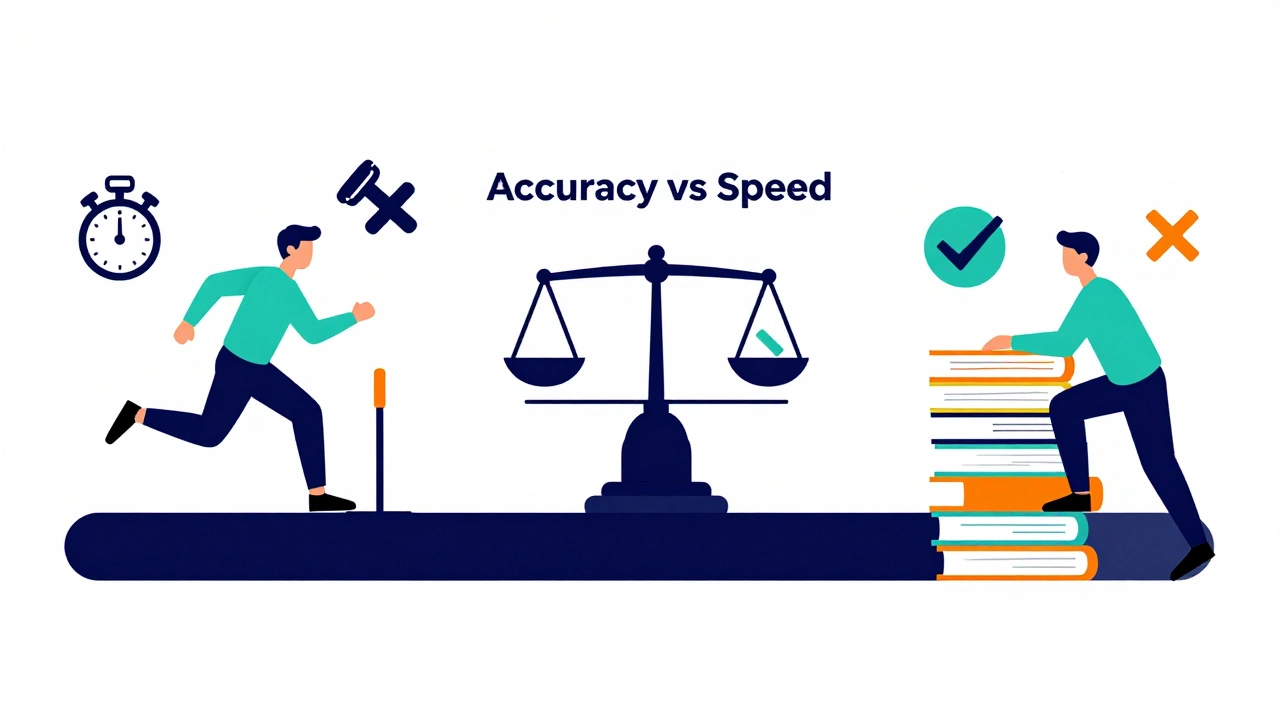
2. Focus on Accuracy, Not Just Speed
In negative marking systems (common in SSC and Banking), guessing is dangerous. Many candidates rush through papers and lose marks. For "easier" jobs, the cutoff is often determined by accuracy. Practice mock tests to identify your weak areas and eliminate them. Aim for 85% accuracy on attempted questions rather than attempting 100% of the paper poorly.
3. Utilize Official Resources
Stop relying solely on third-party apps. Download previous year question papers from official websites like ssc.nic.in, rrb.gov.in, and ibps.in. Analyze the pattern. You’ll notice that 60% of questions are repeated or slightly modified from past years. Mastering these patterns is more effective than reading thick textbooks.
4. Physical Fitness is a Competitive Edge
If you are considering Police, Defense, or even some Forest Guard roles, start your physical training six months before the exam. Many academically superior candidates fail at the PET/PET stage. Being fit doesn't just help you pass the test; it keeps your mind sharp during long study hours.

Common Pitfalls to Avoid
Even when aiming for easier jobs, candidates make costly mistakes. Avoid these traps:
- Ignoring Eligibility Criteria: Age limits, educational qualifications, and domicile requirements are strict. Apply only if you meet every criterion. Disqualification after clearing the exam is heartbreaking and wastes time.
- Chasing Too Many Exams: Quality beats quantity. Pick 2-3 aligned exams (e.g., SSC CHSL + RRB NTPC) and dominate them, rather than scattering energy across ten unrelated notifications.
- Neglecting Document Verification: Keep your caste certificates, mark sheets, and ID proofs ready and attested. Last-minute document issues can disqualify top rankers.
Is It Really "Easy"?
No government job is "easy" in the sense that you can wing it. They all require discipline, consistency, and resilience. However, the mental toll of preparing for SSC MTS or RRB NTPC is significantly lower than preparing for UPSC or Judiciary exams. You can maintain a part-time job or regular studies while preparing for these roles, whereas top-tier exams often demand full-time dedication.
The goal is not to find a job that requires no effort, but to find a job where your effort has the highest probability of success. By targeting roles with high vacancy counts and manageable syllabi, you increase your odds dramatically.
What is the easiest government job for a 10th pass student?
The SSC Multi-Tasking Staff (MTS) exam is widely regarded as the easiest entry point for Class 10 graduates. The syllabus covers basic arithmetic, reasoning, and general awareness at a school-leaving level. Another option is the Railway Group D (now called Level-1) exam, which also targets 10th-pass candidates with similar foundational topics.
How many years does it take to prepare for an easy government job?
For roles like SSC MTS, RRB NTPC, or State Police Constable, focused preparation typically takes 3 to 6 months. If you study 4-5 hours daily and take regular mock tests, you can be exam-ready within this timeframe. This is much shorter than the 2+ years often needed for UPSC or State PCS exams.
Can I crack a government job while working a private job?
Yes, absolutely. Many successful candidates work full-time while preparing. The key is to choose exams with overlapping syllabi (like SSC and Banking) so you don't have to switch contexts constantly. Dedicate early mornings or weekends to study, and use commute time for revision via apps or audio notes.
Are railway jobs easier than bank jobs?
Generally, yes. Railway exams (RRB) tend to have a broader range of posts and slightly lower cutoffs compared to Bank PO/Clerk exams, which are highly competitive due to attractive salaries and perks. However, both require strong quantitative skills. RRB may be slightly more lenient on speed, while banks emphasize rapid calculation.
Does age matter for "easy" government jobs?
Age limits vary by category and role. Most entry-level jobs (SSC, RRB, Police) have an upper age limit of 27-30 years for General category candidates, with relaxations for OBC, SC, ST, and ex-servicemen. Always check the specific notification for the exact age criteria, as they can change annually.