Global Syllabus Difficulty Estimator
Adjust the sliders below to define what makes a syllabus "hard" for you. We will rank five major educational systems based on your criteria.
You’ve probably heard the horror stories. Maybe your cousin struggled through CBSE Class 12 Physics, or you watched a friend cry over an International Baccalaureate Extended Essay at 3 AM. It’s easy to assume that whichever system gave *you* the most headaches must be the toughest globally. But is it? When we strip away the emotional trauma of exam season and look at data, structure, and student outcomes, the answer gets surprisingly complicated.
There is no single "hardest" syllabus because difficulty depends on what you value: raw content volume, conceptual depth, assessment pressure, or time management. However, certain systems consistently rank at the top for sheer academic rigor. We’re talking about the intense memorization demands of traditional Asian curricula, the holistic but exhausting workload of international frameworks, and the high-stakes pressure of national board exams like India’s CBSE and ICSE. Let’s break down who actually carries the heaviest backpack.
Defining "Hardness": What Makes a Syllabus Tough?
Before we pick a winner, we need to agree on the rules of the game. "Hard" isn’t just one thing. Educators and researchers usually measure curriculum difficulty through four distinct lenses:
- Volumetric Load: How much material do students have to cover? Some syllabi require memorizing thousands of facts, dates, and formulas.
- Conceptual Depth: Does the system ask you to regurgitate information, or does it force you to synthesize new ideas? The latter is often harder for younger students.
- Assessment Stakes: Is one final exam worth 100% of your grade? High-stakes testing creates psychological hardness, even if the content is manageable.
- Time Management: Can you finish the work? Systems that demand extensive extracurriculars alongside academics (like IB) test endurance more than intellect.
If you define hardness as "most things to memorize," China’s Gaokao prep wins. If you define it as "most complex thinking required," the International Baccalaureate takes the crown. If you define it as "highest pressure per minute," Indian boards like CBSE and JEE foundations are unmatched.
The Contenders: Top Global Systems Ranked by Rigor
Let’s look at the heavy hitters. These aren’t just random guesses; these are systems frequently cited in OECD PISA results and global educational studies for their intensity.
China: The Gaokao Machine
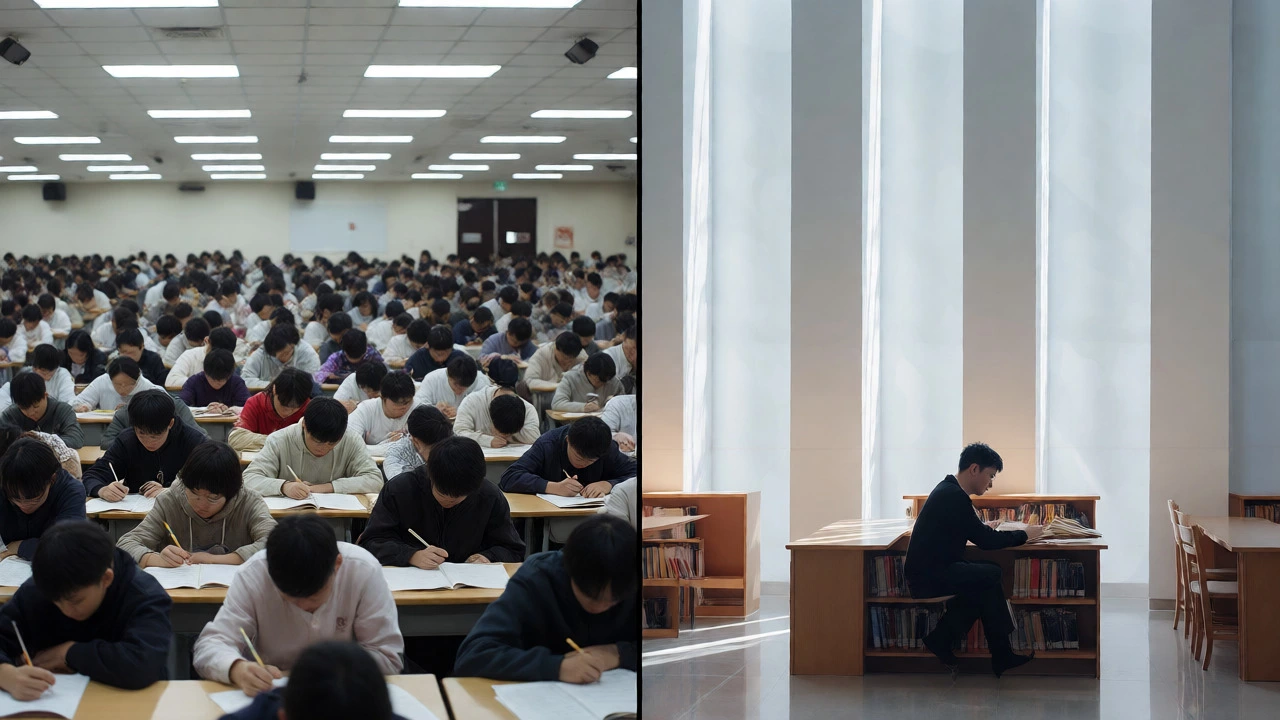
In China, secondary education is dominated by preparation for the Gaokao, the National College Entrance Examination. This isn't just a test; it's a life-defining event. Students study 12-14 hours a day. The syllabus covers advanced mathematics, physics, chemistry, biology, Chinese literature, history, politics, and English. The sheer volume of content is staggering. Unlike Western systems that might spread topics over years, Chinese curricula often compress advanced calculus and quantum physics basics into high school. The difficulty here is endurance. You don’t fail because you’re not smart; you fail because you can’t sustain the pace.
India: CBSE and ICSE Pressure Cookers
Since our context mentions CBSE (Central Board of Secondary Education), let’s address the elephant in the room. Is CBSE the hardest? Globally, it’s certainly up there, but its reputation for difficulty stems less from the syllabus itself and more from the competitive ecosystem surrounding it.
The CBSE syllabus is structured and standardized, designed to feed into entrance exams like JEE (Joint Entrance Examination) and NEET. Here’s the catch: the CBSE board exam is relatively straightforward compared to what students actually study. To crack JEE, a student must master concepts far beyond the standard CBSE scope. So, while the official CBSE syllabus is moderate-to-hard, the effective syllabus for a serious Indian student is brutal. They are effectively studying two curricula simultaneously: one for school grades, and one for elite engineering/medical college admission.
| Syllabus/System | Primary Difficulty Factor | Content Volume | Conceptual Depth | Assessment Style |
|---|---|---|---|---|
| China (Gaokao) | Memorization & Speed | Extremely High | Moderate-High | Single High-Stakes Exam |
| India (CBSE/JEE) | Competition & Volume | High (Effective) | High (for JEE) | Board Exams + Entrance Tests |
| International Baccalaureate (IB) | Holistic Workload | Moderate | Very High | Continuous Assessment + Finals |
| UK (A-Levels) | Specialization Depth | Low (per subject) | Very High | End-of-Year Exams |
| Finland (Matriculation) | Autonomy & Critical Thinking | Moderate | High | Matriculation Exam |
The International Baccalaureate (IB): The Endurance Test
Many expats and private school students argue the International Baccalaureate Diploma Programme is the hardest. Why? Because it refuses to let you specialize. While an A-Level student drops subjects they dislike, an IB student must take six subjects, including a language, a science, a humanity, math, arts/elective, and core components like Theory of Knowledge (TOK) and the Extended Essay (EE).
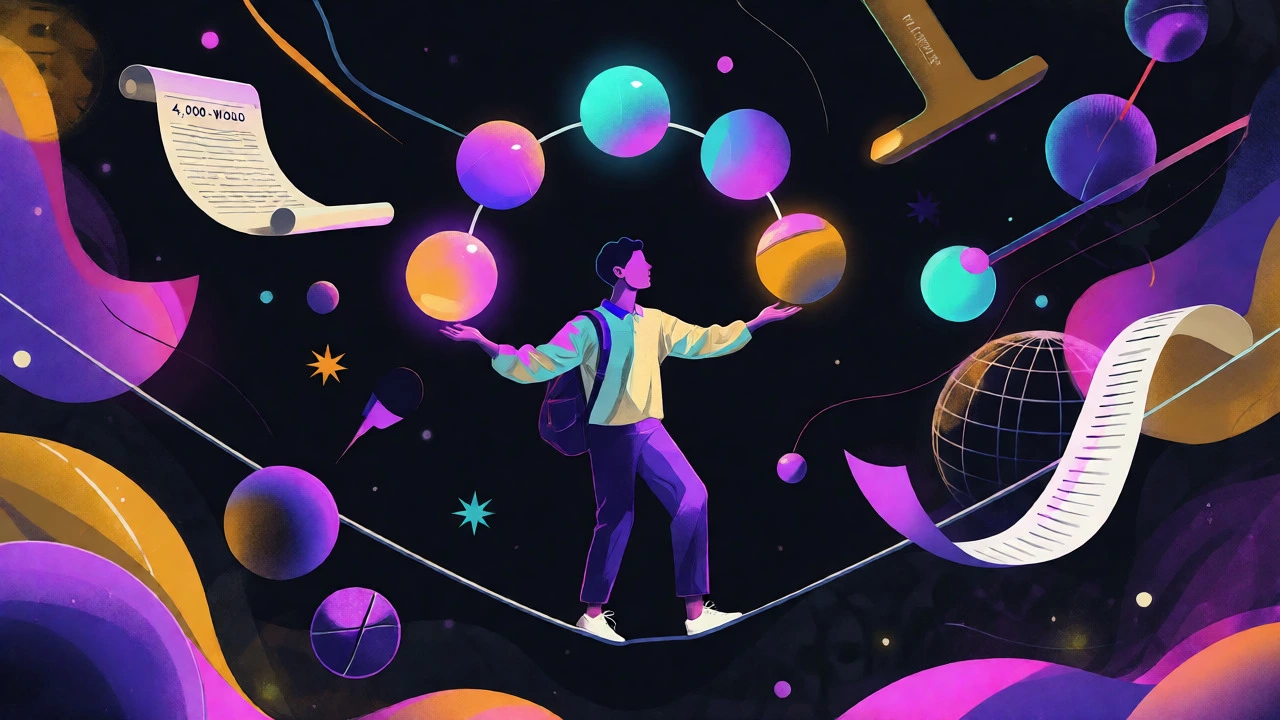
The EE is a 4,000-word research paper-essentially a mini-university thesis written by a 17-year-old. Combined with CAS (Creativity, Activity, Service) requirements, the IB doesn’t just test your brain; it tests your ability to manage chaos. If you struggle with organization, IB will break you. If you love deep dives into philosophy and interdisciplinary connections, you’ll thrive. It’s hard because it’s broad, not because the math is necessarily harder than a Chinese high schooler’s.
United Kingdom: A-Levels Specialization
The UK’s General Certificate of Secondary Education (GCSE) followed by A-Levels is often misunderstood. In Year 12 and 13, students drop everything except three or four subjects. The difficulty spikes dramatically because the depth increases. An A-Level Chemistry student goes deeper into organic mechanisms than many first-year university students in other countries. However, because the breadth is narrow, it’s easier to achieve high scores if you know what you want to study. It’s hard in terms of precision, but manageable in terms of workload compared to IB or CBSE.
Why CBSE Feels Harder Than It Looks
Let’s circle back to the specific mention of CBSE. If you compare the official NCERT textbooks to, say, Finnish or Canadian curricula, CBSE seems dense. It includes topics in Science and Math that some Western schools introduce only in university. For example, Calculus is part of the CBSE Grade 11/12 syllabus, whereas in many US states, it’s an AP elective.
But the real "hardness" of CBSE is cultural. In India, marks determine social status, family honor, and career trajectory. A 95% is average; a 98% is good. This inflation means students push themselves to perfection. The syllabus might be 7/10 in difficulty, but the expectation is 10/10. This mismatch between syllabus design and societal expectation creates a unique type of academic stress that doesn’t exist in lower-pressure systems like Finland’s, where failure is seen as a learning opportunity, not a catastrophe.
Regional Variations: South Korea and Singapore
We can’t ignore East Asia’s other giants. South Korea’s Suneung exam is infamous. Students spend entire days taking tests, and businesses close so latecomers aren’t distracted. The Korean curriculum emphasizes rote learning and speed. Similarly, Singapore’s GCE O/A Levels are known for mathematical rigor. Singaporean primary school math problems often stump adults in other countries. These systems prioritize accuracy and speed above all else. If you’re slow but thoughtful, these syllabi feel impossible. If you’re fast and precise, they’re rewarding.
So, Which One Wins?
If forced to choose, here’s the breakdown based on different definitions of "hard":
- Hardest by Volume & Pressure: China (Gaokao) and South Korea (Suneung). The sheer number of hours and the life-or-death stakes make these physically and mentally exhausting.
- Hardest by Holistic Demand: International Baccalaureate (IB). Balancing six subjects, essays, and service projects requires skills that go beyond textbook knowledge.
- Hardest by Competitive Distortion: India (CBSE + JEE/NEET). The official syllabus is tough, but the extra-curricular coaching culture makes the effective workload unbearable for many.
- Hardest by Conceptual Abstraction: UK A-Levels and French Baccalauréat. These systems reward abstract reasoning and philosophical argumentation, which can be difficult for students trained primarily in factual recall.
Notice a pattern? The "hardest" syllabus depends entirely on your strengths. Are you a grinder? Go for China. Are you a researcher? Try IB. Are you a specialist? Pick A-Levels. Are you a survivor? Well, CBSE will prepare you for anything.
How to Survive Any Hard Syllabus
Regardless of which system you’re in, survival tips remain similar. First, stop comparing yourself to peers in other countries. A student in Finland isn’t studying calculus at 16, but they’re developing critical thinking skills you might lack. Second, focus on understanding, not memorizing. Rote learning works until the questions get tricky. Third, manage your energy, not just your time. Burnout is the real enemy, not the syllabus itself.
Ultimately, the hardest syllabus is the one you’re not prepared for. With the right mindset and strategy, even the Gaokao or IB can be conquered. It’s not about avoiding difficulty; it’s about building resilience.
Is the CBSE syllabus harder than the International Baccalaureate (IB)?
It depends on the metric. CBSE has a higher volume of factual content and is geared toward entrance exams like JEE, making it technically demanding in STEM subjects. IB is harder in terms of workload diversity, requiring extensive writing, critical thinking across disciplines, and time management. Students strong in rote learning may find CBSE easier, while those who prefer holistic assessment may struggle with IB's continuous evaluation.
Which country has the highest academic pressure on students?
South Korea and China are widely considered to have the highest academic pressure due to the single-exam nature of their college admissions (Suneung and Gaokao). India also ranks very high due to the competitive ratio for top institutions, though the pressure is distributed across multiple exams (Boards, JEE, NEET) rather than one single day.
Is the Finnish education system easier than CBSE?
Yes, in terms of homework load and exam frequency, Finland is significantly lighter. There are fewer standardized tests and less emphasis on memorization. However, Finnish students are expected to demonstrate high levels of independent critical thinking and problem-solving, which can be challenging for students accustomed to guided instruction. It is 'easier' in workload but 'harder' in autonomy.
Does the IB curriculum teach more advanced math than CBSE?
Not necessarily. Both cover similar topics like Calculus, Vectors, and Statistics at the Higher Level (HL) for IB and the Senior Secondary level for CBSE. However, CBSE often moves faster through these topics to accommodate entrance exam prep. IB HL Math focuses more on application and modeling, while CBSE focuses on procedural fluency and solving standard types of problems quickly.
Why do Indian students find foreign syllabi easier?
Indian students undergo rigorous training in foundational concepts during their CBSE/ICSE years, especially in Mathematics and Sciences. This early exposure to advanced topics gives them a head start when they switch to systems like A-Levels or AP, which may introduce these concepts later or with less depth initially. Additionally, the high-stakes competition in India builds strong test-taking stamina.