
JEE Subject Priority Analyzer
Enter your estimated marks (out of 100) in each subject from recent mock tests.
Mathematics Focus
Waiting for analysis...
Physics Focus
Waiting for analysis...
Chemistry Focus
Waiting for analysis...
Adjust the sliders and click Analyze to get a personalized study plan based on article insights.
Every year, thousands of students stare at their study plans and ask the same terrifying question: "If I only have time to master one subject, which one should it be?" The answer isn't as simple as pointing to Physics or Mathematics. In the IIT JEE (Joint Entrance Examination), there is no single "most important" subject because the exam is designed to punish imbalance. However, if you look at the data from recent years, a clear hierarchy emerges based on weightage, difficulty, and scoring potential.
To crack this exam, you need to understand that Physics, Chemistry, and Mathematics are not just subjects; they are distinct strategic assets. One builds your foundation, one gives you quick points, and one decides your rank. Let's break down exactly how each subject functions in the high-stakes environment of the JEE Main and Advanced exams.
The Strategic Weightage: Why Math Often Wins
If we define "importance" by the sheer volume of marks available, Mathematics is the highest-weighted section in JEE, carrying significant influence over final ranks due to its extensive syllabus coverage. In both JEE Main and JEE Advanced, Mathematics typically accounts for 30-40% of the total score. This is not a coincidence. The National Testing Agency (NTA) structures the paper so that Math has the most questions and the broadest range of topics.
Why does this matter? Because consistency in Math can stabilize your rank even if you stumble in Physics. Consider the structure: you might get 10 questions out of 30 in Physics right, but if you secure 20 out of 30 in Math, you are already in the top percentile. The problem is that Math is also the most volatile subject. It requires calculation speed and accuracy that many students lack under pressure. A single arithmetic error can cost you four marks, pushing you down hundreds of ranks.
- High Reward: Highest number of questions means more opportunities to score.
- High Risk: Time-consuming problems can eat up your entire slot.
- Syllabus Breadth: Covers Calculus, Algebra, Coordinate Geometry, and Trigonometry extensively.
Physics: The Rank Decider
While Math offers volume, Physics is the conceptual backbone of engineering entrance exams, testing logical reasoning and application of laws rather than rote memory. For students aiming for the top 1000 ranks, Physics is often the differentiator. Why? Because it is harder to guess correctly in Physics compared to Chemistry. If you understand the concept, you solve it. If you don't, you are likely to lose marks due to negative marking.
In JEE Advanced, Physics questions are notoriously complex. They often combine multiple concepts-like linking Electrostatics with Mechanics-in a single problem. This tests your ability to synthesize information quickly. Many toppers report that their final rank was decided by their performance in the last two hours of the Physics section. It demands a deep understanding of principles like Newton's Laws, Thermodynamics, and Modern Physics, rather than just formula memorization.
However, Physics is also the most time-intensive to prepare for from scratch. You cannot cram Physics overnight. It requires building intuition through practice. If your foundation in Class 11 Physics is weak, jumping straight to JEE-level problems will feel like climbing a mountain without oxygen.
Chemistry: The Quick Scorer
Here is the secret that many coaching institutes whisper about: Chemistry is the most efficient subject for rapid score improvement, divided into Physical, Organic, and Inorganic branches with varying preparation strategies. If you are running out of time during the exam, Chemistry is where you grab those extra marks. Unlike Physics and Math, Chemistry questions are often shorter to read and faster to solve, especially in the Inorganic and Organic sections.
Inorganic Chemistry is essentially a memory game. If you have memorized the NCERT textbook thoroughly, you can answer these questions in seconds. Organic Chemistry relies on mechanisms and logic, which, once understood, become predictable. Physical Chemistry involves calculations similar to Math, but usually simpler. This makes Chemistry the "safety net" for your score. Even if you blank out on a tough Physics derivation, a solid Chemistry score can keep your aggregate percentage high enough to qualify for JEE Advanced.
| Subject | Weightage | Difficulty Level | Best For |
|---|---|---|---|
| Mathematics | Highest (30-40%) | High (Time-consuming) | Building bulk score |
| Physics | Moderate (30%) | Very High (Conceptual) | Differentiating top ranks |
| Chemistry | Moderate (30%) | Low to Moderate | Quick marks & stability |
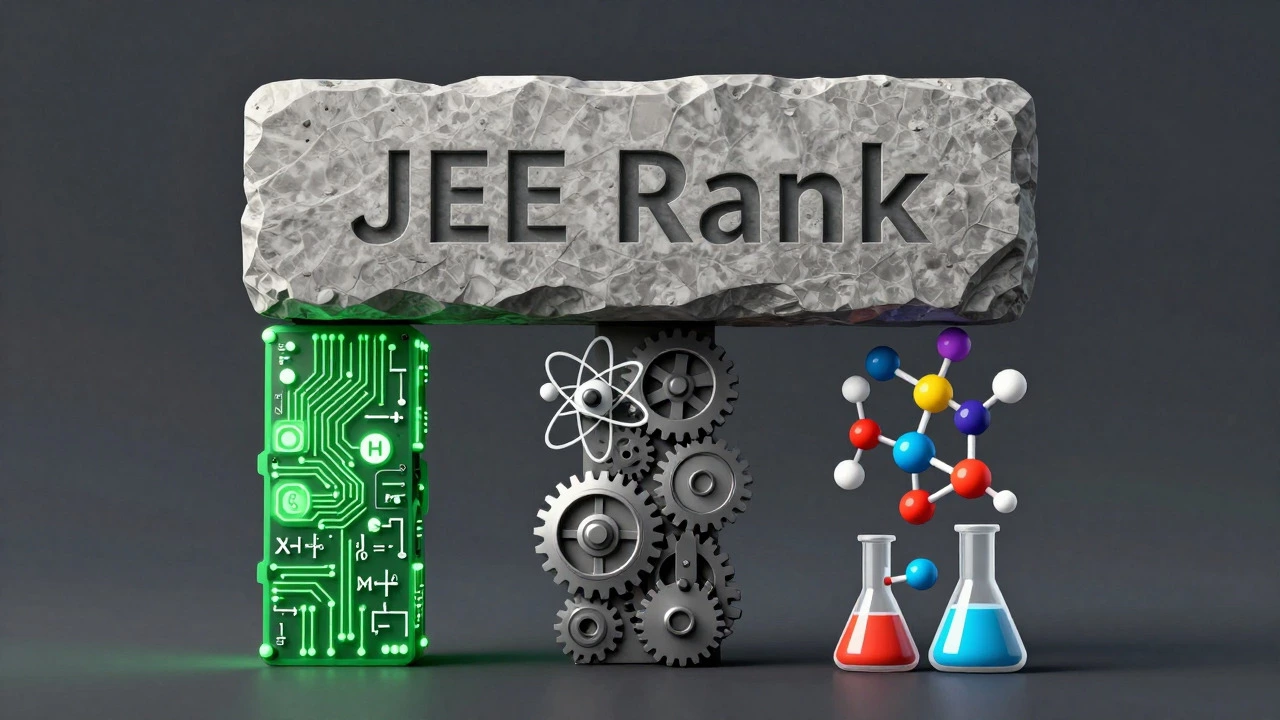
The Interconnected Nature of JEE Syllabus
You cannot treat these subjects in isolation. The beauty-and the trap-of JEE is how they overlap. For instance, Calculus in Mathematics is essential for solving complex integration problems in Physics. Similarly, Equilibrium concepts in Physical Chemistry mirror those in Thermodynamics in Physics. Ignoring one subject often leads to gaps in another.
This interconnectedness means that your "most important" subject depends on your current strengths. If you are strong in Math but weak in Physics, focusing solely on Math won't help you solve the integrated Physics-Math problems that appear in JEE Advanced. You need a balanced approach where you use your strong subject to boost confidence while systematically plugging holes in your weaker areas.
How to Prioritize Based on Your Profile
Not every student needs the same strategy. Here is how you should decide which subject deserves your immediate attention based on where you stand today.
- The Balanced Student: If you are scoring equally in all three, focus on speed. Practice previous year papers to reduce the time taken per question. Your priority is efficiency, not new content.
- The Math-Dominant Student: If Math is your strength, use it to secure a baseline score. Then, shift 60% of your remaining time to Physics. Physics is the ceiling-raiser. Without strong Physics, your Math score alone may not push you into the top IITs.
- The Chemistry-Focused Student: If you struggle with concepts, maximize your Chemistry score first. Aim for 90+ marks in Chemistry. This guarantees you qualify for JEE Advanced. Then, use the safety margin to tackle easier Physics and Math questions.
- The Last-Minute Preparer: If you have less than six months, prioritize Inorganic Chemistry and basic Math formulas. These offer the highest return on investment for limited study hours.
Common Pitfalls in Subject Selection
Many students fall into the trap of ignoring Chemistry because it seems "easy." They spend hours deriving Physics formulas while skipping the NCERT lines for Inorganic Chemistry. This is a fatal mistake. In JEE Main, Chemistry questions are directly lifted from NCERT examples and exercises. Ignoring them is leaving free marks on the table.
Another common error is over-specializing in Math. Students love Math because it feels logical and rewarding. But in the actual exam, Math questions can be lengthy. Spending 45 minutes on two Math problems when you could have solved five Chemistry questions in that time is a strategic failure. Always calculate the "marks per minute" ratio for each subject during mock tests.
Final Verdict: Balance is Key
So, which subject is most important? If forced to choose one for survival, pick Chemistry. It keeps you in the race. If choosing one for glory, pick Physics. It separates the good from the great. And if choosing for volume, pick Math. It fills your scorecard. But the truth is, the JEE does not care about your favorites. It cares about your aggregate. The most successful candidates are those who refuse to let any single subject drag their average below the cutoff. Treat each subject as a pillar supporting your dream; remove one, and the structure collapses.
Is Mathematics really the hardest subject in JEE?
For many students, yes. Mathematics has the highest weightage and requires significant calculation time, making it prone to errors under pressure. However, difficulty is subjective; students with strong logical reasoning often find Physics more challenging due to its abstract concepts.
Can I ignore Inorganic Chemistry and still crack JEE?
It is highly risky. Inorganic Chemistry consists of direct recall questions from the NCERT textbook. Ignoring it means missing out on quick, guaranteed marks that require minimal calculation time, which are crucial for boosting your overall score.
Which subject helps in securing a top rank in JEE Advanced?
Physics is often the key differentiator for top ranks in JEE Advanced. The questions are deeply conceptual and multi-layered. A strong performance in Physics demonstrates the analytical depth required by top IITs, whereas Math and Chemistry scores tend to cluster among high-performing candidates.
How much time should I dedicate to each subject daily?
A balanced approach suggests spending equal time on all three subjects if you are starting early. As the exam nears, adjust based on your weak areas. Generally, Math might require slightly more time for practice problems, while Chemistry can be studied in shorter, frequent bursts for revision.
Does JEE Main have different importance levels for subjects compared to JEE Advanced?
Yes. In JEE Main, Chemistry plays a larger role in qualification due to its straightforward nature. In JEE Advanced, Physics and Mathematics become more critical for ranking because the questions test deeper application and integration of concepts, reducing the advantage of rote learning.