
eLearning Success Predictor
Discover your potential for success in eLearning by evaluating key factors that influence online course completion. Research shows these elements significantly impact learner outcomes.
Select the features that motivate you to keep learning:
Gamification
Badges, points, leaderboardsSocial Learning
Forums, peer reviews, groupsMicrolearning
Short, focused content chunksAdaptive Learning
Personalized paths & feedbackYour Success Potential
Personalized Tips
Picture this: You are sitting in your kitchen in Melbourne, sipping coffee, and suddenly you are attending a lecture from a professor at Harvard. Or maybe you are on a bus in Sydney, refreshing a quiz app to prepare for a certification exam. This is not magic; it is eLearning. But have you ever stopped to wonder what actually happens behind the screen when you click "Start Course"?
Most people think eLearning is just a video on YouTube with a PDF attached. If that were true, we would all be experts by now. The reality is far more complex. eLearning is a sophisticated ecosystem involving software, psychology, data tracking, and instructional design. It works because it connects three distinct layers: the content delivery system, the learner’s interaction, and the administrative backend.
The Core Engine: Learning Management Systems (LMS)
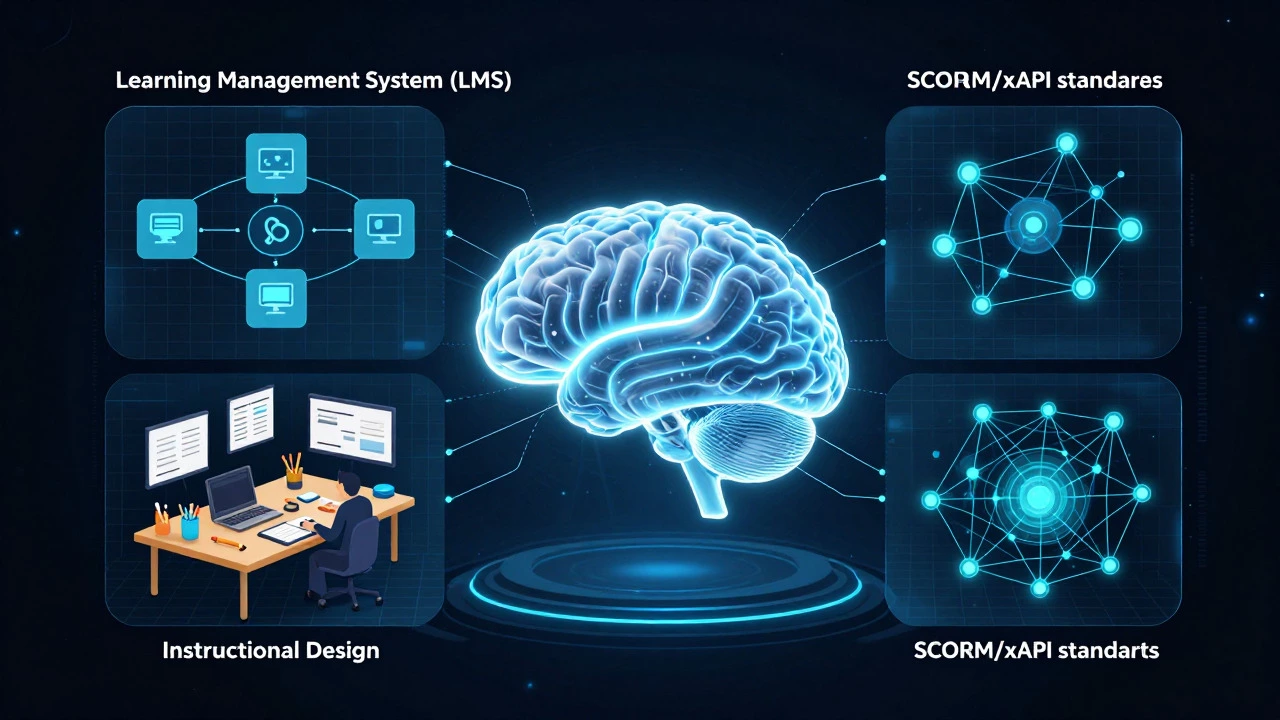
To understand how eLearning works, you first need to meet the engine that drives it: the Learning Management System, or an LMS is a software application used to plan, implement, and deliver an educational course or training program. Think of an LMS as the digital campus. Just as a physical university has classrooms, libraries, and administration offices, an LMS has modules for hosting videos, forums for discussion, and dashboards for grading.
When you log into a platform like Coursera, Udemy, or a corporate training portal, you are interacting with an LMS. These systems handle the heavy lifting. They store your progress, ensure you watch the full video before unlocking the next chapter, and calculate your final grade based on quiz scores. Without an LMS, eLearning would be chaos-just a bunch of unorganized files scattered across email inboxes.
Popular LMS platforms include Moodle, Canvas, Blackboard, and TalentLMS. Each serves a slightly different purpose. Moodle is open-source and highly customizable, making it a favorite for universities. Canvas is known for its user-friendly interface, appealing to K-12 schools. Corporate environments often use specialized versions focused on compliance training, ensuring employees complete mandatory safety courses by specific deadlines.
How Content Is Created: Instructional Design
You might assume that creating an online course is as simple as hitting record on a webcam. In professional eLearning, that is rarely the case. The process follows a structured methodology known as Instructional Design, which is the practice of creating educational experiences which make the acquisition of knowledge and skill more efficient.
One of the most common frameworks used here is the ADDIE model. It stands for Analysis, Design, Development, Implementation, and Evaluation. Let's break down what that means in practice:
- Analysis: Who is the audience? What do they already know? What skills are they missing? For example, if you are teaching Python coding to beginners, you don't start with advanced algorithms. You start with variables.
- Design: How will the information flow? Will it be text-heavy or visual? Will there be quizzes after every module? This stage creates the blueprint or storyboard for the course.
- Development: This is where the actual content is built. Graphic designers create slides, videographers shoot footage, and developers code interactive simulations.
- Implementation: The course is uploaded to the LMS and made available to learners.
- Evaluation: Did it work? Did learners pass the exams? Were the instructions clear? Feedback loops help improve future iterations.
This rigorous process ensures that the content isn't just informative but also engaging and effective. It transforms raw information into a structured learning journey.
The Technology Behind the Scenes: SCORM and xAPI
Here is a technical detail that most learners never see, but it is crucial for how eLearning works: standardization protocols. Imagine if every car manufacturer used a different shape for gas caps. You couldn't fill up your tank anywhere. Similarly, early eLearning was fragmented. Every software tool spoke its own language.
Enter SCORM (Sharable Content Object Reference Model). SCORM is a set of technical standards for eLearning interoperability. It allows content created in one authoring tool (like Articulate Storyline) to run smoothly on any compliant LMS (like Moodle). When you finish a SCORM-compliant module, the LMS knows exactly what score you got, how long you spent on it, and whether you completed it. It sends this data back to the central database automatically.
In recent years, a newer standard called xAPI (or Tin Can API) has emerged. While SCORM tracks basic completion and scores, xAPI tracks almost anything. It can record that you watched a video, clicked a specific button in a simulation, or even discussed a topic in a forum. This granular data helps organizations understand not just if you finished the course, but how you learned. Did you struggle with a particular concept? Did you skip ahead? xAPI provides the insights needed to personalize future learning paths.
| Feature | SCORM | xAPI (Tin Can) |
|---|---|---|
| Data Granularity | Basic (completion, score, time) | Detailed (interactions, context, performance) |
| Connectivity | LMS-centric | Learning Record Store (LRS) centric |
| Use Case | Traditional compliance training | Skill-based, experiential learning |
| Adoption | Widely adopted, legacy standard | Growing rapidly in modern tech |
Engagement Strategies: Keeping Learners Motivated
Let's be honest: staring at a screen can be boring. One of the biggest challenges in eLearning is dropout rates. Studies consistently show that a significant percentage of users who enroll in online courses never finish them. So, how does eLearning combat this? Through deliberate engagement strategies.
First, there is gamification. This doesn't necessarily mean turning everything into a video game. It involves using game-design elements in non-game contexts. Badges, leaderboards, points, and streaks trigger our brain's reward system. Completing a module gives you a sense of achievement, encouraging you to move to the next one. Platforms like Duolingo master this art, using streaks to keep users coming back daily.
Second, microlearning breaks content into small, digestible chunks. Instead of a two-hour lecture, you get five-minute videos focused on single concepts. This respects the learner's attention span and fits better into busy schedules. You can learn something while waiting for your coffee to brew.
Third, social learning fosters community. Discussion forums, peer reviews, and group projects mimic the collaborative environment of a physical classroom. Knowing that others are going through the same experience reduces isolation and increases accountability. If you post a question and receive helpful answers from peers, you feel connected to the material and the community.
Accessibility and Global Reach
One of the most powerful aspects of eLearning is its ability to democratize education. Geographical barriers disappear. A student in a remote village in India can access the same quality resources as a student in New York City, provided they have an internet connection.
However, accessibility goes beyond location. Modern eLearning platforms prioritize inclusive design. This includes closed captions for videos to assist hearing-impaired learners, screen reader compatibility for visually impaired users, and adjustable font sizes. It also means offering content in multiple languages. Translation tools and localized content allow global audiences to participate fully.
Furthermore, asynchronous learning-the ability to study at your own pace-levels the playing field for working professionals and parents. They don't need to rearrange their lives around a fixed class schedule. They can learn during lunch breaks, late nights, or weekends. This flexibility is a cornerstone of why eLearning has grown so explosively over the last decade.
The Role of Data and Analytics
In traditional classrooms, teachers rely on intuition and periodic tests to gauge understanding. In eLearning, data is everywhere. Every click, hover, pause, and replay is recorded. This wealth of information allows for adaptive learning.
Imagine a system that notices you struggling with a specific math problem. Instead of letting you fail the final exam, the system automatically suggests a review video or an extra practice quiz on that specific topic. This is adaptive learning in action. It personalizes the educational experience based on real-time performance data.
For organizations, analytics provide ROI (Return on Investment) metrics. HR departments can see which training programs lead to higher employee productivity or lower error rates. Educational institutions can identify which courses have high dropout rates and investigate why. Is the content too difficult? Is the technology glitchy? Data-driven decisions replace guesswork, leading to continuous improvement.
Challenges and Limitations
Despite its benefits, eLearning is not a silver bullet. It faces several challenges. The digital divide remains a significant issue. Not everyone has reliable high-speed internet or a modern device. This creates inequality between those who can access digital learning and those who cannot.
Self-discipline is another hurdle. Without the structure of a physical classroom and the presence of a teacher, procrastination becomes easy. Many learners underestimate the time required to complete courses, leading to frustration and abandonment.
Additionally, some subjects are harder to teach online. Hands-on skills like surgery, welding, or laboratory chemistry require physical practice. While virtual reality (VR) and augmented reality (AR) are beginning to bridge this gap, they are not yet ubiquitous. Hybrid models, combining online theory with offline practical sessions, often yield the best results for these fields.
The Future of Digital Learning
As we look toward the rest of 2026 and beyond, eLearning continues to evolve. Artificial Intelligence (AI) is becoming a major player. AI tutors can answer student questions instantly, providing personalized explanations tailored to individual learning styles. Natural Language Processing (NLP) allows for more intuitive interactions, where students can ask questions in plain English rather than navigating complex menus.
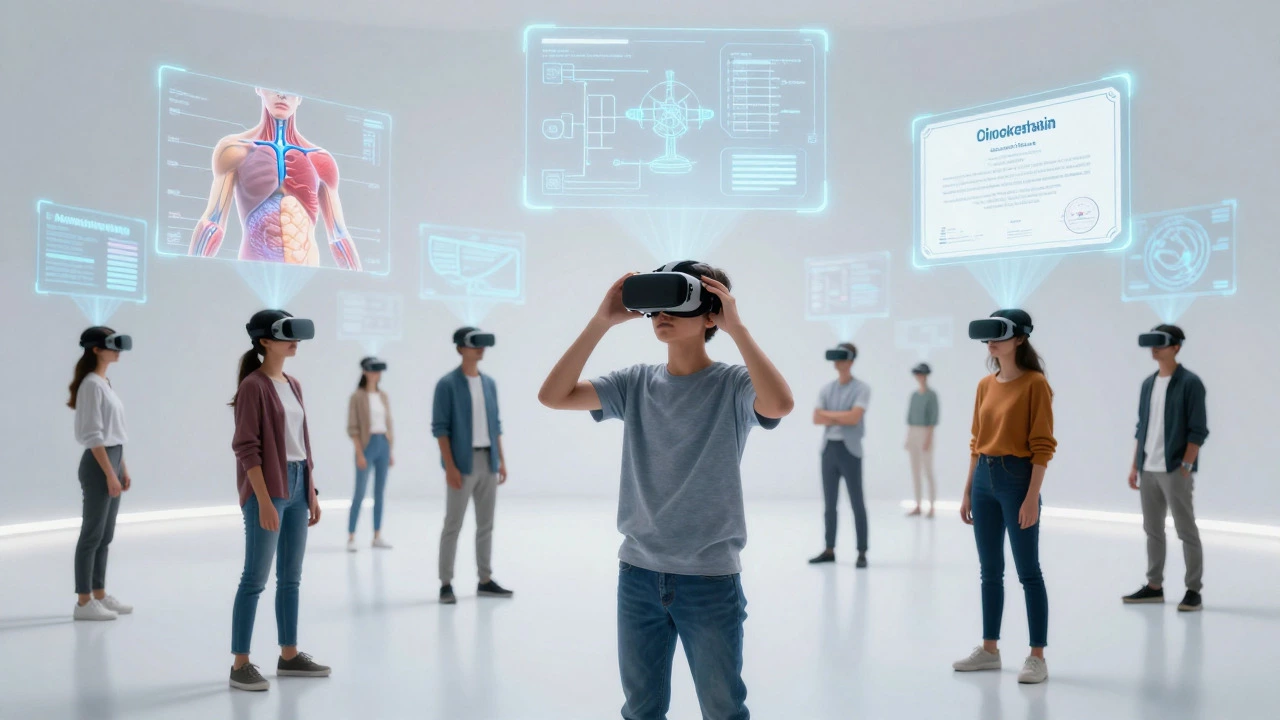
Virtual Reality (VR) is transforming immersive learning. Medical students can practice surgeries in a risk-free virtual environment. Engineers can walk through 3D models of buildings before construction begins. These technologies offer experiential learning opportunities that were previously impossible or prohibitively expensive.
Blockchain technology is also being explored for credentialing. By storing certificates and achievements on a decentralized ledger, learners can own their credentials permanently. Employers can verify qualifications instantly without contacting issuing institutions, reducing fraud and streamlining hiring processes.
Is eLearning as effective as traditional classroom learning?
Research shows that eLearning can be just as effective, if not more so, than traditional methods, particularly when it incorporates active learning strategies like quizzes, discussions, and simulations. However, effectiveness depends heavily on the quality of instructional design and the learner's self-discipline. Blended learning, which combines both approaches, often yields the highest satisfaction and retention rates.
What is the difference between an LMS and an LCMS?
An LMS (Learning Management System) delivers and tracks learning. An LCMS (Learning Content Management System) is used to create and manage the content itself. Think of the LCMS as the factory where content is built, and the LMS as the store where it is sold and consumed. Some modern platforms combine both functionalities.
Do I need special software to take an online course?
In most cases, no. Modern eLearning platforms are web-based and accessible through standard browsers like Chrome, Firefox, or Safari. Some advanced courses may require specific plugins for video playback or interactive simulations, but these are usually free and easy to install. Mobile apps are also widely available for learning on the go.
How do employers view online certifications?
Employer perception varies by industry and platform. Certifications from reputable providers like Coursera, edX, or LinkedIn Learning are generally well-regarded, especially for tech and business skills. However, for regulated professions, formal degrees from accredited institutions may still be required. Always check job descriptions to see which credentials are valued.
Can eLearning replace human teachers entirely?
While AI and automation are advancing rapidly, human teachers provide mentorship, emotional support, and nuanced feedback that machines currently struggle to replicate. The trend is shifting towards hybrid models where technology handles content delivery and assessment, freeing up teachers to focus on personalized guidance and critical thinking development.