
MBA Program Length Estimator
Calculate Your MBA Duration
When you're thinking about getting an MBA, one of the first questions you’ll ask is: how many years is an MBA? It’s not a one-size-fits-all answer. The time it takes to finish depends on your situation, your goals, and the type of program you choose. Some people finish in a year. Others take three or more. Let’s cut through the noise and give you the real breakdown.
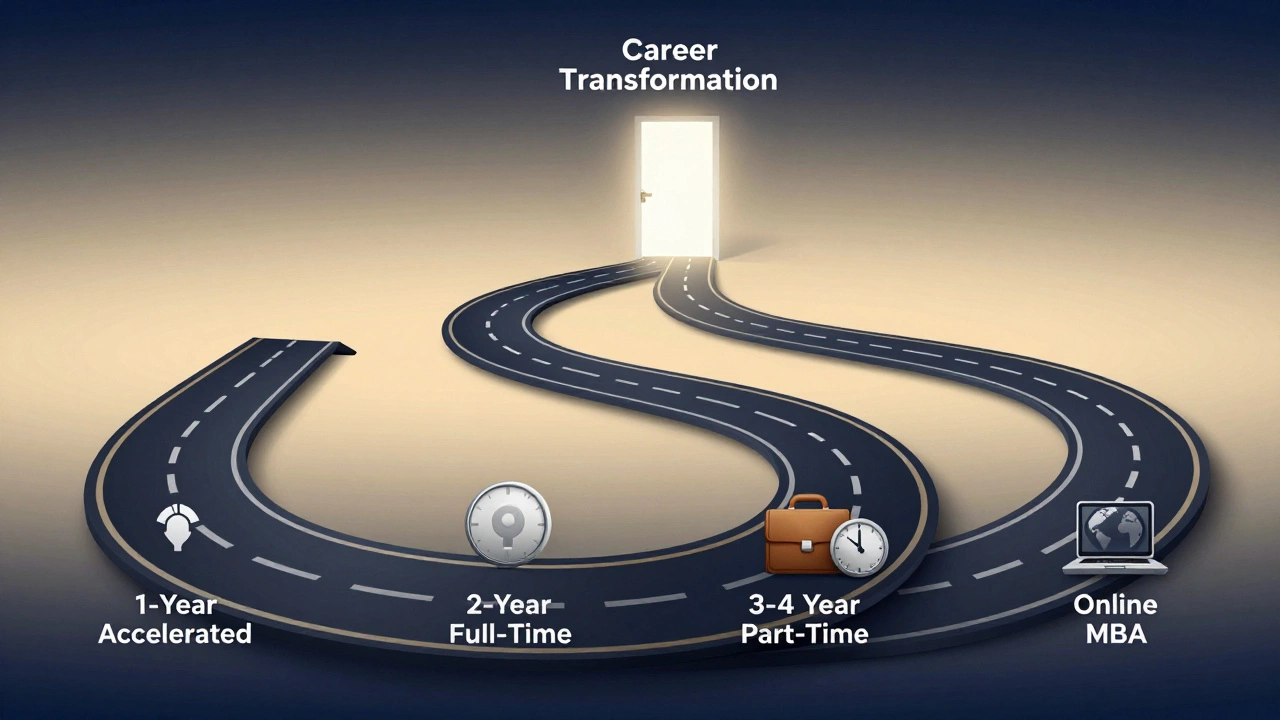
Full-Time MBA: The Classic 2-Year Path
The traditional MBA you see in movies or business magazines usually takes two years. This is the most common format for people who can step away from work to focus on school. The first year is all about core classes-finance, marketing, operations, leadership. The second year is where you specialize, do internships, and build your network.
Why two years? Because it’s designed to reset your career. You’re not just learning. You’re changing. You switch industries, move cities, or even countries. Companies recruit heavily during this time. Many students land their next job through campus placements after the summer internship between year one and two.
Top U.S. schools like Harvard, Stanford, and Wharton still run this model. But it’s not just American. Schools in Europe, Australia, and Canada follow similar timelines. In Melbourne, for example, the University of Melbourne’s full-time MBA is structured over 24 months with a mandatory international exchange module.
Accelerated MBA: One Year, Intense Focus
Want to get back to work faster? Then look at a one-year MBA. These programs are packed. No summer break. No internship. You go hard from day one to graduation.
They’re popular in Europe-schools like INSEAD, London Business School, and IE Business School offer them. But more U.S. and Australian programs are catching up. For example, the Australian National University (ANU) and Melbourne Business School both have 12-month options.
Who’s this for? People who already have solid work experience, know exactly what they want, and don’t need a career pivot. If you’re moving up within your company or switching roles in the same industry, a one-year MBA makes sense. But if you’re switching industries-say from engineering to consulting-you’ll miss out on the internship and networking that make the two-year path so powerful.
Part-Time MBA: Stretch It Out Over 3-4 Years
If you’re working full-time and can’t afford to stop earning, a part-time MBA is your best bet. Classes usually happen in the evenings or on weekends. You take one or two courses per semester.
Most part-time programs take three to four years to complete. Some schools let you go slower if you need to. At Monash University in Melbourne, students can stretch their part-time MBA over five years if life gets busy.
The upside? You keep your salary, apply what you learn right away, and often get employer support. The downside? It takes longer. You’ll be juggling work, family, and homework for years. But if you’re disciplined, this path can be the most practical.

Online MBA: Flexible Timing, Same Degree
Online MBAs have exploded since 2020. Today, you can get the same degree as someone on campus-but with total control over your schedule. Most online programs are designed to be completed in two to three years.
Some schools offer accelerated online tracks that finish in 18 months. Others let you take one class at a time and finish in four years. It depends on how much you can handle.
Top online programs-like those from Indiana University, USC, and the University of Sydney-offer live virtual classes, group projects, and even international residencies. The degree doesn’t say "online." Employers recognize them. And if you’re in a remote job or live far from a campus, this might be your only realistic option.
Executive MBA (EMBA): For Leaders, Not Beginners
EMBA programs are for people who already have 10+ years of leadership experience. These aren’t for fresh grads. You’re expected to be managing teams, budgets, or entire divisions.
Most EMBA programs last 16 to 24 months. Classes meet every other weekend or once a month. Many include international modules-think a week in Singapore, a weekend in New York.
Because EMBA students are already working, the curriculum focuses on strategic leadership, global markets, and board-level decision-making. You won’t be learning how to calculate NPV from scratch. You’ll be debating how to restructure a global supply chain.
In Australia, EMBA programs at UNSW, UQ, and Melbourne Business School are designed for senior managers. You’ll be learning alongside other executives, not students in their 20s.
What Factors Change the Length?
It’s not just about the program type. Your choices matter too:
- Full-time vs. part-time-This is the biggest factor. Full-time = faster. Part-time = slower.
- Course load per term-Some schools let you take more credits. More credits = quicker finish.
- Internship requirements-If you need to do a 3-month internship, that adds time.
- Thesis or capstone project-Some programs require a research project, which can add a semester.
- Work experience-Some schools waive prerequisites if you’ve worked in finance or analytics. That can shorten your path.
Also, check if your school offers summer sessions. Many do. Taking a class in June or July can knock off a few months.
Real-World Examples: What People Actually Do
Let’s look at three real cases:
- Case 1: Sarah, 28, left her marketing job in Sydney to enroll in a full-time MBA at Melbourne Business School. She finished in 22 months, landed a product manager role at Atlassian, and doubled her salary.
- Case 2: James, 35, stayed in his engineering job in Perth while doing an online MBA from the University of Adelaide. He took two courses per semester and graduated in 36 months. His company paid half the tuition.
- Case 3: Priya, 42, was a regional director in healthcare. She did an EMBA over 20 months, attending classes every other weekend. She moved into a C-suite role right after graduation.
There’s no "right" length. Only the right fit for your life.
How to Decide What’s Right for You
Ask yourself:
- Can I afford to stop working for a year or two?
- Do I need to change industries, or am I just climbing the ladder in my current one?
- Do I need the internship and campus recruiting network?
- Am I comfortable learning online, or do I need in-person interaction?
- What’s my end goal? A promotion? A career switch? Starting a business?
If you’re unsure, talk to alumni. Most schools have mentor programs. Ask them: "What would you do differently?" You’ll get answers no brochure can give you.
Bottom Line
So, how many years is an MBA? It can be one, two, three, or even four. The length isn’t about prestige. It’s about alignment. The best program for you isn’t the shortest. It’s the one that fits your life, your goals, and your budget.
Don’t chase the fastest path. Chase the right one.
Can you finish an MBA in one year?
Yes, you can finish an MBA in one year, but only if you choose an accelerated program. These are intense, with no summer break and no internship. They’re best for experienced professionals who already know their career direction. Schools like INSEAD, Melbourne Business School, and ANU offer them. But if you’re looking to switch industries, a one-year program might not give you enough time to build connections or gain new skills.
Is a two-year MBA better than a one-year MBA?
It depends on your goals. A two-year MBA gives you time to explore, intern, switch careers, and build a network. It’s ideal if you’re changing industries, moving countries, or entering a competitive field like consulting or finance. A one-year MBA is better if you’re already established and just need a credential to move up. Neither is "better." One is just more suited to your situation.
Are online MBAs respected by employers?
Yes, especially from top schools. Employers care more about the school’s reputation and your performance than the delivery format. Online MBAs from the University of Sydney, Indiana University, and USC are just as respected as their on-campus versions. The degree doesn’t say "online." What matters is the skills you gained and the network you built.
Do part-time MBAs take longer because they’re less rigorous?
No. Part-time MBAs have the same curriculum, professors, and graduation requirements as full-time programs. You just spread it out over more semesters. The workload is often heavier because you’re balancing it with a full-time job. Many students say part-time programs are harder because they have less time to study.
Can I switch from a part-time to a full-time MBA?
Most schools don’t let you switch formats once you’ve started. But some offer flexibility. For example, if you get a promotion and can now afford to leave your job, some programs allow you to accelerate your part-time track by taking extra courses per semester. Talk to your program advisor early if you think your situation might change.
Is there a maximum time limit to finish an MBA?
Yes. Most MBA programs require you to finish within five to six years from the date you start. This is to ensure the knowledge stays current. If you take too long, you might need to retake older courses. Always check your school’s policy-some let you pause for medical or family reasons, but you’ll need to apply for an extension.