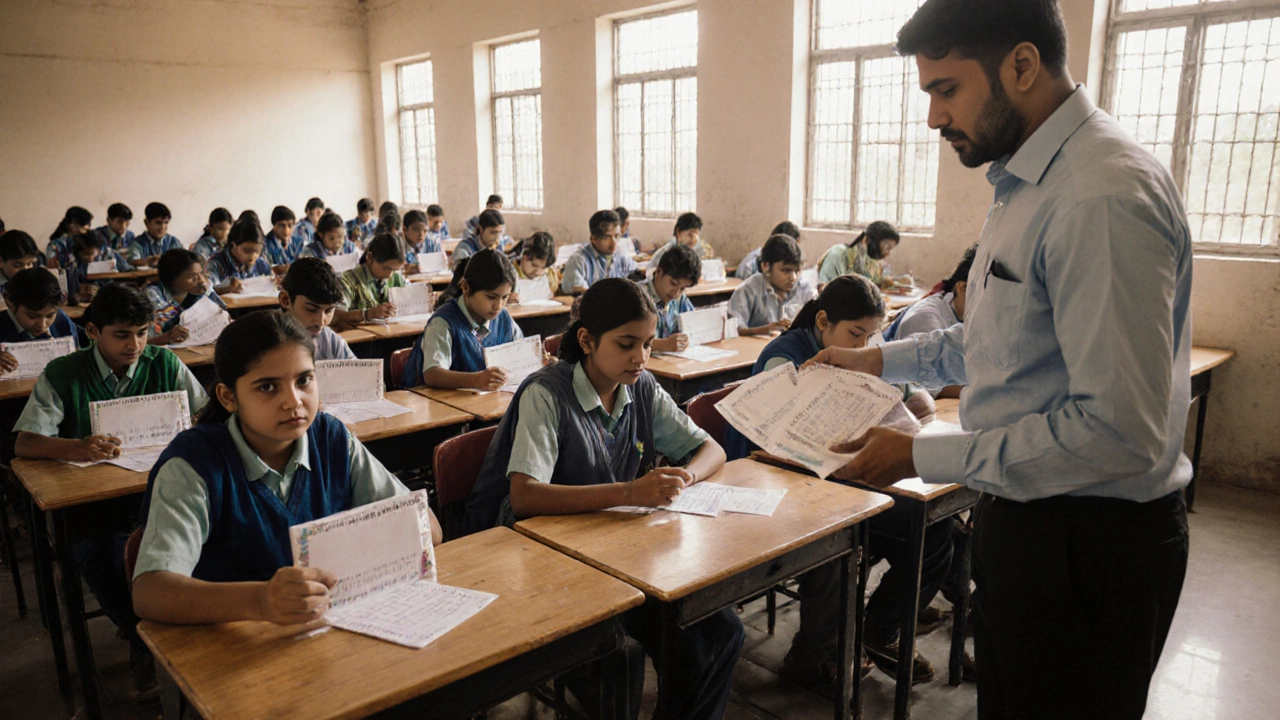
Every year, as exam season rolls around, parents and students in Delhi, Mumbai, Kerala, and Jammu ask the same question: Is CBSE paper the same all over India? The answer isn’t just yes or no-it’s about how the system works, why it matters, and what you should actually expect when your child sits down for those final exams.
Yes, the CBSE question paper is identical nationwide
For Class 10 and Class 12 board exams, CBSE prepares one single set of question papers for every center across India and even abroad. That means a student in Srinagar gets the exact same English paper as a student in Chennai. The same math paper is printed in New Delhi, Guwahati, and even in Dubai or Kuwait where CBSE-affiliated schools operate.
This isn’t just policy-it’s built into the system. CBSE follows a centralized exam model. The question papers are set by a committee of subject experts appointed by CBSE headquarters in Delhi. These papers go through multiple rounds of review, printing under strict security, and are then shipped in sealed packets to every exam center. No regional office has the authority to change the paper.
Why? Because CBSE was designed to ensure fairness. A student from a small town in Odisha shouldn’t be at a disadvantage because their school has fewer resources than a private school in Bangalore. The same paper levels the playing field.
But wait-what about internal assessments and practicals?
While the final board paper is identical, not everything is. Internal assessments, practical exams, and project work are conducted locally. For example:
- In Science, students perform lab experiments under the supervision of their school teachers.
- In Commerce, Business Studies students might present a project on local market trends.
- In Computer Science, coding tasks are evaluated by school staff using CBSE-provided rubrics.
These components are graded by the school, but they follow strict CBSE guidelines. The marking scheme, weightage, and evaluation criteria are standardized. So while the task might vary slightly-like choosing between a solar energy project or a water conservation study-the expectations and scoring are the same nationwide.
What about different exam centers? Do they get different sets?
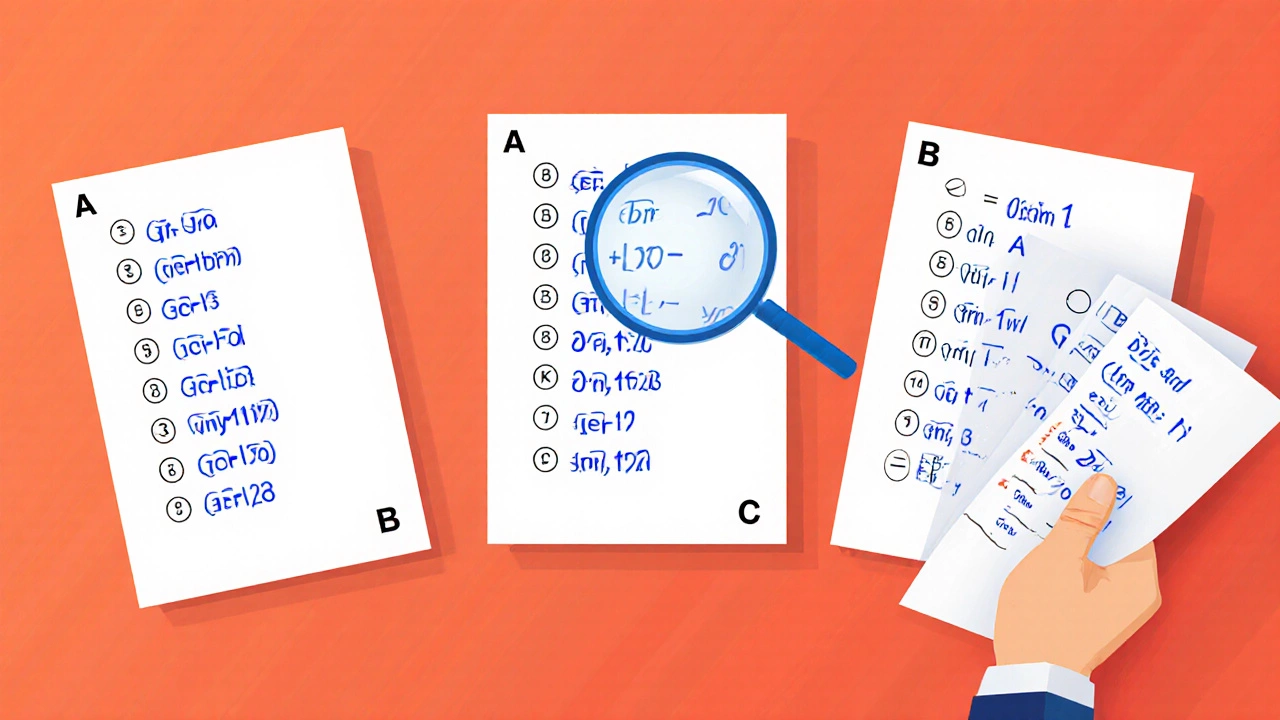
CBSE does not give different papers to different centers. But it does use multiple sets of the same paper to prevent cheating. For example, if there are 100 centers in a city, you might get Set A, while the school next door gets Set B. Both sets have the same questions, difficulty level, and marking scheme-just reordered.
Let’s say you’re taking the Class 10 Science paper. Set A might have Question 1 about photosynthesis as a 3-mark question, while Set B has it as a 5-mark question. But the content? Identical. The concepts tested? The same. The syllabus coverage? Unchanged.
This is why students are told not to share paper details after the exam. Even if two students sit side by side, their papers might look different at first glance-but they’re testing the exact same knowledge.
Is the difficulty level the same everywhere?
Yes. CBSE ensures that every paper, regardless of location, has the same balance of easy, medium, and difficult questions. The board uses a standardized blueprint that specifies:
- How many marks are allocated to each unit (e.g., 20 marks for Algebra in Class 10 Math)
- How many questions should be application-based vs. memory-based
- What percentage of the paper should test higher-order thinking skills
This blueprint is followed rigidly. So if a student in Rajasthan gets a tricky numerical in Physics, a student in Tripura gets the same one-just maybe in a different order. The difficulty isn’t adjusted for region, language, or school type.
That’s why some students find CBSE papers hard. It’s not because they’re from a rural school. It’s because the paper is designed to test understanding, not rote learning-and it’s the same for everyone.

What about language? Do students get papers in regional languages?
CBSE offers question papers in English and Hindi only. That’s it. Even if you’re in Tamil Nadu or West Bengal, your paper will be in English or Hindi. Schools may teach in regional languages, but the board exam itself doesn’t change.
Students who are more comfortable in their mother tongue often struggle with this. But CBSE doesn’t provide papers in Bengali, Telugu, Marathi, or Punjabi. The reason? Standardization. If every state got papers in its own language, the board would lose control over consistency, fairness, and evaluation.
That’s why CBSE encourages students to prepare in English, especially for subjects like Science and Math, where technical terms are universal.
What about students with disabilities or special needs?
CBSE does make accommodations-but not by changing the paper. Students with visual impairments get question papers in Braille. Those with learning disabilities get extra time. Students with physical disabilities can use scribes. But the content? Still the same.
These are accessibility adjustments, not content modifications. The goal isn’t to lower the bar-it’s to remove barriers so every student can reach it.
Why does CBSE do this? The bigger picture
CBSE isn’t just an exam board. It’s a national standard. When a student from a government school in Bihar scores 90% in Chemistry, that mark means the same thing as a 90% from a private school in Gurgaon. Colleges, universities, and even employers trust CBSE marks because they know the standard is uniform.
Compare that to state boards. In Uttar Pradesh, the UP Board paper might focus more on local history. In Maharashtra, the Marathi board might emphasize regional literature. But CBSE doesn’t care where you live. It cares what you know.
This uniformity is why CBSE is the preferred board for students planning to take JEE, NEET, or apply to universities abroad. International institutions recognize CBSE because it’s consistent. A 95% in CBSE Class 12 from Mumbai is the same as a 95% from Lucknow.
What if my school teaches extra topics?
Some schools, especially private ones, teach beyond the CBSE syllabus. Maybe your teacher added an extra chapter on quantum physics in Class 11 Physics. Or your coach drilled you on advanced calculus problems.
Don’t worry. The CBSE paper will only test what’s in the official syllabus. Anything extra is bonus knowledge, not required. CBSE releases the syllabus every year on its website. It’s detailed, chapter-by-chapter. If it’s not in the syllabus, it won’t be on the paper.
Students who rely on coaching material that goes beyond the syllabus often waste time. Focus on the CBSE textbook and sample papers. That’s your real guide.
What about the 2025 exam pattern? Has anything changed?
For 2025, CBSE still follows the same structure: 80 marks for the final board paper, 20 marks for internal assessment. The distribution of questions-MCQs, short answer, long answer-remains unchanged from 2024. The syllabus hasn’t been reduced or expanded.
The only real change is in how the paper is delivered. CBSE now uses digital question paper management systems. But again, the content? Still identical across the country.
Bottom line: CBSE keeps it fair, not easy
So, is the CBSE paper the same all over India? Yes. And that’s the point.
It doesn’t matter if you’re studying in a village school with no internet or a metro school with AI tutors. You’re judged on the same standards. The same questions. The same expectations.
That’s why CBSE remains the most trusted board in India. It doesn’t favor the rich, the urban, or the well-connected. It rewards preparation, understanding, and consistency.
If you’re preparing for CBSE, don’t waste time wondering if your paper will be easier or harder than someone else’s. It won’t be. Focus on mastering the syllabus. Practice past papers. Understand the marking scheme. That’s your only path to success.
Because in CBSE, your location doesn’t define your grade. Your effort does.
Are CBSE question papers the same for all states in India?
Yes, CBSE prepares one set of question papers for all centers across India and abroad. Whether you’re in Ladakh or Kerala, you’ll get the same paper for Class 10 and Class 12 board exams. The content, difficulty, and marking scheme are identical nationwide.
Do CBSE papers have different versions for different centers?
Yes, but only to prevent cheating. CBSE releases multiple sets (like Set A, Set B, Set C) with the same questions in a different order. The topics tested, difficulty level, and marks distribution are exactly the same. You might see questions rearranged, but not changed.
Is the CBSE syllabus the same for all schools in India?
Yes. All CBSE-affiliated schools, whether public or private, must follow the same syllabus released by CBSE headquarters. Schools can’t add or remove chapters. The syllabus is published annually on cbse.gov.in and is mandatory for all.
Can I take the CBSE exam in my regional language?
No. CBSE only offers question papers in English and Hindi. Even if your school teaches in Tamil, Bengali, or Marathi, the board exam will be in English or Hindi. This ensures uniformity in evaluation and recognition across the country and internationally.
Why do some students find CBSE papers hard?
CBSE papers are designed to test conceptual understanding, not memorization. They include application-based and analytical questions that require problem-solving skills. Since the same paper is given to all students, regardless of school quality, it can feel challenging-especially if you’ve only practiced rote learning.
Does CBSE reduce the paper difficulty for rural students?
No. CBSE does not adjust paper difficulty based on region, school type, or economic background. The same standard applies to every student. However, accommodations like extra time, scribes, or Braille papers are provided for students with disabilities to ensure equal access-not easier content.
Are CBSE board exams easier than state board exams?
It’s not about easier or harder-it’s about different. CBSE focuses on conceptual clarity and application, while many state boards emphasize rote learning and local content. CBSE is more aligned with national entrance exams like JEE and NEET, which is why it’s preferred by students aiming for competitive careers.
Can I use coaching material that goes beyond the CBSE syllabus?
You can, but don’t rely on it for the board exam. CBSE only tests content listed in its official syllabus. Coaching material that covers advanced topics might help with competitive exams like JEE, but for CBSE boards, stick to NCERT textbooks and CBSE sample papers. Anything extra is bonus, not required.