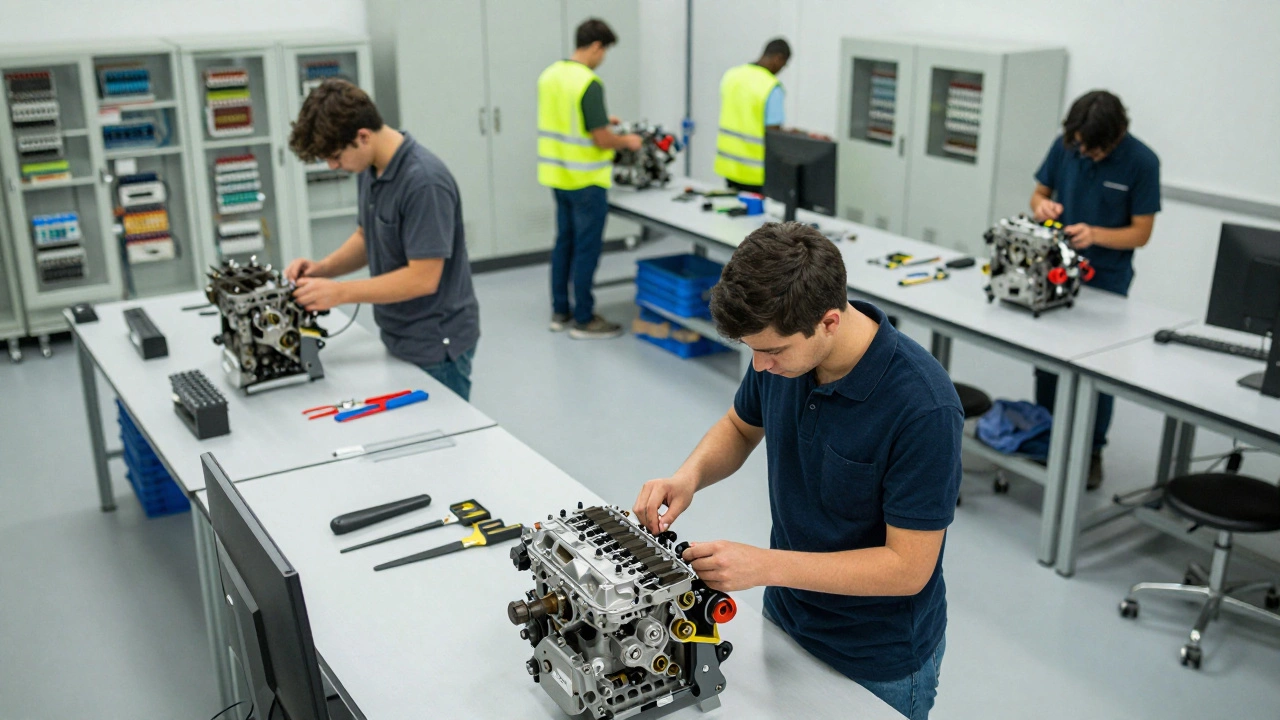
Most people think going to college is the only way to get a good job. But what if you could start earning a steady income in six months-without student debt-by learning how to fix cars, install solar panels, or code websites? That’s vocational training. It’s not about theory. It’s about doing. And it’s growing fast, especially in places like Australia where skilled trades are in high demand.
What Exactly Is Vocational Training?
Vocational training is hands-on education that prepares you for a specific job. Unlike traditional degrees that focus on broad knowledge, vocational programs teach you the exact skills employers need right now. You learn by doing-wiring circuits, stitching garments, operating CNC machines, or managing a kitchen. The goal? Walk out ready to work.
This kind of training goes by many names: trade school, TAFE (in Australia), apprenticeship, or career and technical education (CTE). But they all mean the same thing: you’re learning a trade, not a subject.
In Australia, over 1.2 million people are enrolled in vocational training each year. The government funds many of these programs because industries like construction, healthcare, and IT can’t find enough qualified workers. It’s not second-tier education. It’s targeted, practical, and often faster than university.
How Is It Different From University?
Think of university as learning how to build a car. Vocational training is learning how to fix one.
University degrees usually take three to four years. You study history, philosophy, or economics-even if you’re majoring in engineering. Vocational courses last from a few weeks to two years. You spend most of your time in workshops, labs, or on-site with mentors.
Cost is another big difference. A university degree in Australia can cost $10,000 to $40,000 per year. A Certificate III in Electrotechnology? Around $2,000 to $5,000-with government subsidies for eligible students. Many programs even pay you while you learn through apprenticeships.
And the job outcomes? In 2024, 82% of vocational graduates found full-time work within four months. That’s higher than the rate for bachelor’s degree holders in some fields.
Real Examples of Vocational Training Programs
Let’s look at actual programs people are doing right now-and the jobs they lead to.
- Certificate III in Carpentry - You learn to read blueprints, frame walls, install roofs, and use power tools safely. After finishing, you can work for a builder, start your own small business, or move into project management. In Melbourne, qualified carpenters earn between $70,000 and $95,000 a year.
- Certificate IV in Dental Assisting - You train in sterilizing instruments, taking X-rays, scheduling appointments, and supporting dentists during procedures. Many graduates work in private clinics. The demand is rising as Australia’s population ages. Starting pay is around $55,000.
- Certificate III in Information Technology (Network Administration) - No computer science degree needed. You learn how to set up routers, troubleshoot networks, manage user accounts, and secure systems. Companies like Telstra and Coles hire these graduates directly. Average salary: $65,000.
- Certificate III in Automotive Mechanical Technology - You work on engines, brakes, transmissions, and diagnostics. Many programs partner with Toyota, Ford, or local garages. Apprentices get paid while they learn. After completion, you can become a licensed mechanic with job security for decades.
- Certificate III in Early Childhood Education and Care - You learn child development, safety protocols, activity planning, and how to support kids with special needs. Childcare centers across Australia are desperate for trained staff. Starting salary: $58,000, with opportunities to become a center director.
These aren’t hypotheticals. These are real people-some fresh out of high school, others switching careers after 30-working in stable, well-paid jobs because they chose skill over theory.

Who Is Vocational Training For?
It’s not just for people who didn’t do well in school. It’s for anyone who learns better by doing.
Think about it:
- You’re 17 and hate sitting in lectures but love taking things apart to see how they work.
- You’re 32 and tired of the 9-to-5 grind but want a job where you can see the results of your work.
- You’re a parent who needs flexible hours and doesn’t want to spend years in debt.
- You’re someone who wants to work locally-not move to a big city for a corporate job.
Vocational training fits all of them. There’s no one-size-fits-all path. You can do it full-time, part-time, online, or while working. Many programs offer weekend or evening classes. Some even let you start with a short course to test the waters before committing.
And the best part? You don’t need perfect grades. You need motivation, a willingness to learn, and the ability to show up on time.
Where Can You Get Vocational Training in Australia?
In Australia, the main providers are TAFE institutes and private Registered Training Organisations (RTOs). TAFE is government-run and usually cheaper. Private RTOs can be more specialized or offer faster-paced programs.
Here’s where to look:
- TAFE Victoria - Offers hundreds of courses across Melbourne and regional areas. You can apply online and check funding eligibility.
- Skills Victoria - The state’s skills portal. It lists subsidized courses and apprenticeship opportunities.
- My Skills website - A national database. Search by course, location, or job outcome. It shows pass rates, employer satisfaction, and average salaries.
Don’t just pick the first course you see. Look at the outcomes. Ask: Do past students get jobs? Are employers hiring from this program? Is there a pathway to further certification?
Common Myths About Vocational Training
Let’s clear up some misunderstandings.
- Myth: It’s only for people who can’t get into university. - False. Many university graduates go back for vocational training to add practical skills. A nurse with a Certificate IV in Advanced First Aid earns more and has better job options.
- Myth: These jobs don’t pay well. - Wrong. Electricians, plumbers, and welders often earn more than graduates in arts or social sciences. Skilled trades have wage premiums because of demand.
- Myth: You’re stuck in the same job forever. - Not true. Many electricians become contractors. Many childcare workers become center managers. Many IT support staff move into cybersecurity. Vocational training is a launchpad, not a dead end.
- Myth: It’s not respected. - Changing fast. With labor shortages, employers are begging for skilled workers. The stigma is fading. In fact, many parents now encourage their kids to consider trades.

How to Get Started
Here’s a simple step-by-step plan:
- Identify your interest. What do you enjoy doing? Fixing things? Helping people? Working with your hands? Using computers?
- Research jobs. Go to My Skills and search for roles you like. Look at the required qualifications.
- Check funding. See if you qualify for government subsidies. Many courses cost less than $1,000 if you’re under 25 or unemployed.
- Visit a TAFE or RTO. Talk to a course advisor. Ask for student success stories.
- Start small. Enroll in a short course or try an apprenticeship. You don’t need to commit to two years right away.
One man in Geelong, 45, lost his warehouse job in 2023. He enrolled in a 12-week course in forklift operation. Six weeks later, he was hired. Now he earns $72,000 a year. He didn’t go back to school. He went to TAFE.
Why This Matters Now
The future of work isn’t just about AI and remote jobs. It’s about people who can fix, build, maintain, and care for the world we live in. Automation is replacing routine tasks-but not skilled labor.
By 2030, Australia will need 1.2 million more workers in skilled trades. That’s a massive gap. And vocational training is the bridge.
If you’re looking for a job that’s stable, pays well, and doesn’t require a mountain of debt, vocational training isn’t just an option. It’s one of the smartest moves you can make.
Is vocational training free in Australia?
No, it’s not free, but many courses are heavily subsidized by the government. If you’re under 25, unemployed, or meet certain income criteria, you might pay as little as $100 to $500 for a full qualification. Programs like Skills First in Victoria cover a large portion of the cost. Always check eligibility before enrolling.
Can I do vocational training while working?
Yes, many programs are designed for working adults. You can study part-time, online, or during evenings and weekends. Some employers even sponsor staff to complete vocational qualifications. Apprenticeships combine paid work with structured training-so you earn while you learn.
Do employers value vocational training?
Absolutely. In industries like construction, healthcare, IT support, and hospitality, employers prefer candidates with hands-on qualifications over theory-based degrees. A Certificate III in Electrotechnology means you can already wire a house safely. That’s worth more to an employer than a 3-year degree with no practical experience.
Can vocational training lead to university later?
Yes. Many TAFE qualifications give you credit toward a university degree. For example, completing a Diploma in Nursing can reduce a three-year degree to two years. Some universities even have direct entry pathways for vocational graduates. It’s a flexible ladder, not a dead end.
Are there vocational jobs that don’t require physical labor?
Definitely. Many vocational courses focus on tech, administration, or care. Examples include IT support, cyber security, dental assisting, aged care, childcare, and business administration. These jobs require skill and knowledge-but not heavy lifting. They’re just as respected and in demand.
Next Steps
If you’re thinking about vocational training, don’t wait for the perfect moment. Start with one small step: visit My Skills and search for a course that interests you. Look at the job outcomes. Talk to someone who’s done it. Visit a local TAFE. The path isn’t always obvious-but it’s there, and it’s waiting for you.