There’s no single answer to which IIT branch is the toughest-because the toughest one isn’t always the one with the hardest syllabus. It’s the one that matches your weakest point. For some, it’s the math-heavy courses. For others, it’s the endless labs, the 12-hour study days, or the pressure of being the top student in a batch of 500 others who all scored 99.9 percentile in JEE Advanced.
What Makes a Branch Tough?
People often assume the toughest branch is the one with the most complex theory. But that’s not how it works in real life. The difficulty of an IIT branch comes from three things: workload, expectations, and how much you’re forced to adapt.
Take Computer Science and Engineering (CSE). It’s not the hardest subject in terms of physics or calculus. But it’s the most demanding in hours. Students in CSE often spend 10-14 hours a day coding, debugging, or preparing for hackathons. The projects don’t wait. The deadlines don’t move. And if you fall behind in the first semester, catching up means pulling all-nighters every week.
Compare that to Mechanical Engineering. The theory is dense. Thermodynamics, fluid mechanics, and machine design require deep conceptual understanding. But the workload is more spread out. You have labs on certain days, theory on others. You get weekends. CSE? You don’t.
Computer Science: The Invisible Grind
CSE is the most popular branch at every IIT. That’s not because it’s easy-it’s because it leads to high-paying jobs. But popularity doesn’t mean it’s less tough. It means more people are willing to burn out for it.
At IIT Bombay, the average CSE student completes 8-10 major projects by the end of their third year. That’s not optional. It’s expected. One student told me he spent 60 hours straight fixing a single bug in a distributed system project. He didn’t sleep. He didn’t eat properly. He just kept going. And that’s normal.
The real pressure? Everyone around you is equally brilliant. You’re not competing against 10,000 JEE candidates anymore. You’re competing against 100 of the top 100 in the country. If you’re not coding every day, you’re falling behind.
Electrical Engineering: The Hidden Beast
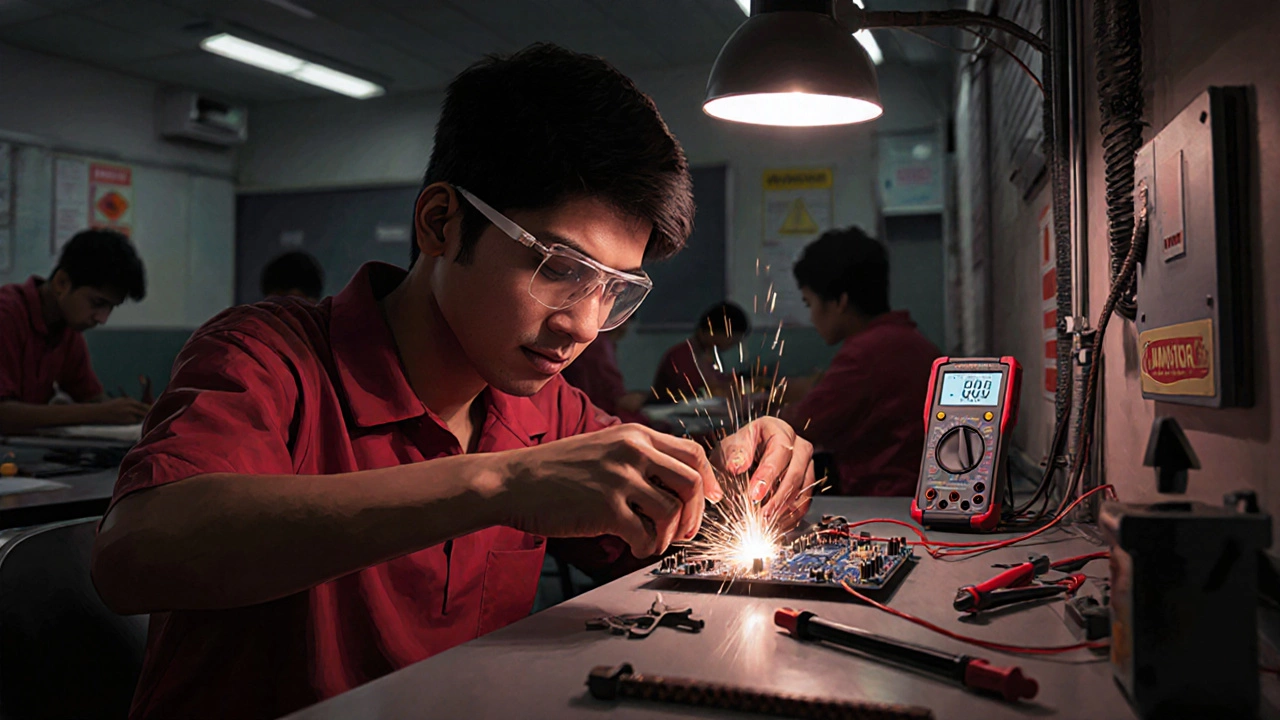
Electrical Engineering (EE) is where theory meets chaos. The syllabus covers analog circuits, digital systems, power electronics, control theory, and signal processing-all in one degree. It’s like learning five different engineering fields at once.
And the labs? They’re brutal. You’re not just reading a manual. You’re wiring circuits that can blow up if you make one mistake. One wrong connection, and your entire lab session is ruined. No second chances. No redo.
At IIT Delhi, EE students often say the third year is the hardest. That’s when you start working with high-voltage systems. One wrong move, and you risk injury. The professors don’t joke around. You’re expected to know every component, every formula, every safety rule. And the exams? They test not just memory, but instinct.
Chemical Engineering: The Misunderstood Challenge
Chemical Engineering is often dismissed as “easy” because it’s not about coding or circuits. But that’s a mistake. It’s the branch that demands the most mental flexibility.
You’re learning thermodynamics like a physicist, fluid dynamics like a mechanical engineer, reaction kinetics like a chemist, and process design like an industrial engineer. You’re not just memorizing formulas-you’re building entire systems in your head.
At IIT Madras, the Chemical Engineering department has the lowest pass rate in the first year. Why? Because the math is brutal. The problems are multi-layered. You need to solve for temperature, pressure, flow rate, and reaction rate-all at once. One small error in unit conversion, and your entire solution is wrong.
And then there’s the stigma. Many students choose Chemical Engineering because they didn’t get CSE. But those who stick with it? They’re the ones who learn to think in systems. And that skill? It’s priceless.
Why Physics-Based Branches Are Harder Than You Think
Branches like Physics, Mathematics and Computing (M&C), and even Aerospace Engineering might not have the same name recognition as CSE or EE-but they’re just as tough, if not tougher.
M&C at IIT Delhi is a hybrid of pure math and computer science. You’re taking courses like Real Analysis, Abstract Algebra, and Numerical Methods alongside data structures and algorithms. The professors assume you already know calculus at a graduate level. If you’re not comfortable with proofs, you’ll struggle.
Aerospace Engineering? You’re learning orbital mechanics, aerodynamics, and materials science-all with zero room for error. One miscalculation in thrust-to-weight ratio, and your design fails. And the labs? You’re working with wind tunnels and simulation software that runs for days.
What About Civil and Architecture?
Civil Engineering gets labeled as “easy” because it’s not coding or electronics. But it’s not. The math is heavy. The design standards are strict. You’re learning to design bridges that can survive earthquakes, buildings that won’t collapse in high winds. One mistake, and lives are at risk.
Architecture at IIT Roorkee is even more intense. You’re doing 12-hour studio sessions, drawing by hand, building physical models, and presenting to panels who critique every line. You’re graded on creativity, technical accuracy, and presentation-all at once. And the workload? It doesn’t stop during holidays.

It’s Not the Branch. It’s You.
Here’s the truth: no branch is objectively the toughest. It’s the one that doesn’t match your strengths.
If you hate coding, CSE will break you. If you hate math, Chemical Engineering will crush you. If you hate sitting still for long hours, EE’s theory-heavy exams will drain you.
Many students switch branches after the first year. Why? Because they picked based on rank, not interest. They thought CSE meant money. They didn’t realize it meant sleepless nights, constant pressure, and a lifestyle built on caffeine and deadlines.
At IIT Kharagpur, around 15% of students change branches after the first semester. Most move from CSE to EE or Mechanical. Why? Because they realized they could handle theory better than code. Others go from Civil to M&C because they liked math more than design.
The toughest branch isn’t the one with the most papers. It’s the one that makes you question why you’re there.
What Should You Choose?
Don’t pick a branch because it’s “hard.” Pick it because it excites you.
Ask yourself:
- Do I love solving problems with code, or do I prefer building physical systems?
- Can I sit through 3 hours of math proofs without zoning out?
- Do I enjoy working in teams on long-term projects, or do I prefer solo work?
- Am I okay with not having weekends for the next four years?
If you’re good at math but hate coding, go for M&C or EE. If you like hands-on work, Mechanical or Civil might suit you better. If you’re okay with constant pressure and love tech, CSE is fine-but know what you’re signing up for.
There’s no shame in choosing a less popular branch. IITs have produced some of the world’s best engineers from Chemical, Metallurgy, and even Textile Engineering. The brand is IIT. Not the branch.
Final Thought: Hard Work Beats Hard Branches
The students who thrive at IIT aren’t the ones who scored the highest in JEE. They’re the ones who kept going after failing a midterm. Who asked for help. Who stayed after class. Who learned to manage stress, not just exams.
The toughest branch isn’t the one with the most exams. It’s the one that makes you give up. And if you’re willing to push through? You’ll find that every branch, no matter how hard, becomes manageable with persistence.
Choose the branch that feels like a challenge you want to take on-not one you’re forced into.
Is Computer Science really the toughest branch at IIT?
Computer Science is the most demanding in terms of time and mental stamina, not necessarily complexity. Students often spend 10-14 hours a day coding, debugging, or working on projects. The pressure comes from constant deadlines, high expectations, and competing with peers who are equally skilled. If you dislike coding or can’t handle long hours, CSE will feel overwhelming-even if the theory is easier than other branches.
Which IIT branch has the lowest pass rate?
Chemical Engineering at IIT Madras has historically had the lowest first-year pass rate among major branches. This is due to its heavy reliance on multi-variable calculus, thermodynamics, and process design-all requiring precision and deep conceptual understanding. A single calculation error can invalidate an entire problem. The workload is also spread across many subjects, leaving little room for error.
Can you switch branches after joining IIT?
Yes, most IITs allow branch changes after the first year based on CGPA and availability. Around 10-15% of students switch each year, usually from CSE to EE or Mechanical if they find coding too intense. The cutoff CGPA for switching to CSE is often above 9.0, making it one of the hardest branches to enter through transfer.
Is Electrical Engineering harder than Computer Science?
Electrical Engineering is harder in theory and lab work. You deal with high-voltage systems, complex circuit designs, and physical components that can fail dangerously if mishandled. Computer Science is harder in terms of workload and mental fatigue. EE tests your precision and safety awareness; CSE tests your endurance and consistency. Neither is easier-it’s just different.
Should I pick a branch based on placement packages?
No. While CSE and EE often have the highest average salaries, picking a branch solely for placements leads to burnout. Many students who force themselves into CSE end up switching or dropping out. The best placements go to students who are genuinely interested in their field. Passion drives performance, not the other way around.
Do IITs have easier branches for students who struggle with math?
No. All IIT branches require strong math skills, especially in the first two years. Even branches like Architecture and Civil Engineering involve calculus, statistics, and structural analysis. If you struggle with math, you’ll need to build your foundation early-through coaching, tutoring, or extra practice. There’s no escape from math at IIT.
If you’re preparing for JEE, focus on building strong fundamentals in physics, math, and chemistry-not just to get into IIT, but to survive it. The branch you get is just the starting point. What you do after that matters far more.